
Hunting Forecast
|
10/02/2026
Quail Hunting Forecast 2026
Coveys Will Rise: A Good Year to Follow a Bird Dog
by Ryan Sparks
Related Articles


Some years have quail hunters grasping at reasons for hope. This isn't one of them.
Across the Great Plains and Midwest, mild winter weather and timely moisture helped carry birds into spring and provided good nesting and brood-rearing habitat. The quail responded and hunters in several Midwest states should be excited for the season to come.
The Southeast is a familiar story. Wild bobwhites hold on where prescribed fire, timber management, and early-successional habitat remain on the landscape. From Arkansas and Georgia to the Carolinas and Virginia, some of the most encouraging reports once again came from properties where people are actively managing for quail.
Head west and conditions become more complicated. Drought and wildfire have reshaped portions of quail country from Texas to Washington. But there are always silver linings. Drought sets back thick stands of non-native grass. Wildfires create early succession habitat.
That theme is woven throughout our state forecasts: good habitat gives quail a fighting chance.
And habitat is the heart of Quail Forever's mission, alongside creating more places for hunters to follow a bird dog and experience wild quail.
So dive into this year's forecasts, check out your home state, and start planning a trip to somewhere in quail country you've never been. There is plenty of wild quail country left to explore.
Keep Up the Good Fight,
Ryan Sparks, Quail Forever Journal Editor
Before you go: Make sure your Quail Forever membership is current or consider increasing your support. If you aren't a member, join us in our mission to create a landscape that supports wild, sustainable populations of upland birds and other wildlife.
Alabama
Quail Hunting Forecast 2026 - Alabama
Follow the Fire
By Russell Worth Parker
Habitat Conditions
Quality habitat remains the primary limiting factor for Alabama bobwhites, but properties receiving intensive management continue to demonstrate what is possible when fire, timber thinning, and other habitat practices are put to work.
"Quality habitat is the main limiting factor for quail in Alabama, and the Southeast has lost much of the quality upland habitat conducive to healthy quail numbers," says Caleb Blake, Upland Game Bird Coordinator for the Alabama Department of Conservation and Natural Resources. "However, on properties that emphasize intensive habitat management, the habitat should be in good shape heading into the fall season."
Winter weather appears to have had little direct impact on Alabama's quail population. Although periods of extreme cold arrived late in the season, Blake describes the winter as relatively mild overall and does not believe temperatures adversely affected quail.
Private land manager and forester Ted DeVos agrees.
"Our populations are driven way more by predator issues and habitat conditions than some type of weather anomaly," DeVos says. "So, I don't think it had any effect to speak of."
Drought was potentially more consequential.
Quail hunter and guide Durrell Smith points out that Alabama entered December following its second-driest July-through-December stretch on record, with drought eventually touching the entire state. Those conditions can mean thinner cover and reduced seed production heading into winter.
"Bobwhites in well-managed fire country are built to weather a few hard nights if the cover is there," Smith says. "That's the caveat, though: if the cover is there."
Smith encountered wild coveys last season, although they tended to be small and scattered. He also found birds using hardwood drainages and edges in addition to more obvious feeding areas.
"Where the habitat was right, birds came through winter," he says. "Where it was marginal, the drought took its toll."
For current drought conditions, consult the U.S. Drought Monitor.
Prescribed fire is the most important habitat tool for Alabama land managers. Smith points to the Choccolocco WMA Quail Emphasis Area in Cleburne County, where 13 burn units are managed on a two-year rotation along with grain plantings. Farther south, Boggy Hollow WMA encompasses approximately 7,000 acres of longleaf savanna co-managed with the U.S. Forest Service in the Conecuh.
Recent National Fish and Wildlife Foundation Longleaf Stewardship funding is also supporting prescribed fire and longleaf restoration projects across Alabama. The Nature Conservancy, Alabama Forestry Foundation, Alabama Wildlife Federation, Tall Timbers and other partners are involved in work stretching from the Talladega Mountains to the Chattahoochee Fall Line.
"The good news is that fire is going on the ground at real scale," Smith says. "Where the fire goes, the birds follow."
Quail Numbers
Alabama's wild quail are scattered throughout the state, and populations differ dramatically depending on habitat and management.
The Alabama Division of Wildlife and Freshwater Fisheries conducts annual fall covey-call counts and spring male-whistle counts on numerous Wildlife Management Areas. According to Blake, results vary considerably by WMA, with some areas recording no quail during survey periods. Overall, average counts appeared slightly lower than in 2025.
Summer observations offer a mixed picture. Biologists managing some of Alabama's more popular quail WMAs have reported several broods and are optimistic heading into fall, while other areas have produced few brood observations. Reports from intensively managed private properties have generally been more encouraging.
"Several private landowners who intensively manage for quail report strong brood numbers on their properties," Blake says, "reiterating the importance of good management for promoting quail productivity."
DeVos has seen a similar pattern.
"From what I've seen, we had a pretty good hatch, but that's relatively speaking, because our populations are so scattered, with isolated pockets here and there," he says.
Those isolated populations also make Alabama difficult to characterize with a single statewide outlook. What constitutes a huntable population can vary dramatically between intensively managed properties and the broader landscape.
"If you live in South Georgia, a bird to the acre is barely a huntable population," DeVos says. "But if you live in central Alabama, a bird per 20 acres is probably a huntable population."
Hunters looking for a good wild quail starting point should look at the Wiregrass. Blake points to its long quail-hunting history and the continued commitment of landowners to habitat management. Properties with good habitat and huntable populations can also be found in Alabama's Ridge and Valley and Piedmont regions.
"I would steer hunters towards the Wiregrass region of Alabama," Blake says. "There are also huntable populations on public land if one knows where to look."
DeVos likewise describes the Wiregrass as a natural holdout for wild birds, thanks in part to its agricultural landscape and abundance of field edges. The Union Springs and Hurtsboro area also contain some of Alabama's largest concentrations of intensively managed wild-quail habitat.
Access
Alabama's best quail numbers are generally found on intensively managed private properties, but dedicated hunters can still find wild birds on public land.
Barbour WMA in southeastern Alabama offers more than 28,000 acres of public ground in the heart of the Wiregrass region. Smith also recommends the longleaf country of Covington and Escambia counties, particularly Conecuh National Forest and Boggy Hollow WMA.
Boggy Hollow's roughly 7,000 acres of longleaf-wiregrass savanna are managed with frequent prescribed fire. Quail hunting there is controlled through limited hunting days and a reduced bag limit designed to manage hunting pressure.
Alabama's Black Belt also remains central to the state's quail culture. Bullock County and the Union Springs area are home to historic bird dog and field trial grounds as well as private properties managed intensively for wild quail. Although much of that habitat is privately owned, guided hunts, hunt clubs, and field trials provide opportunities to experience the region's quail tradition.
For hunters targeting public land, Blake recommends looking beyond a WMA's name or reputation and concentrating instead on recent habitat work.
"If you're hunting public land, look for areas that have had intensive timber thinning combined with frequent fire on the ground," Blake says. "I also encourage hunters to look for two- to three-year-old clear cuts. If they have been burned and have had enough time for adequate cover to establish, quail often flock to these open areas."
Smith offers an even simpler rule: follow the fire.
Before hunting a property, determine what has been burned during the previous year or two. Recently burned longleaf and wiregrass habitat can be particularly productive, especially along firebreaks, food plot margins and other edges. Calling the local WMA biologist or district office can help hunters identify where recent management has occurred.
"All in all," Blake says, "nothing beats putting tires to gravel and boots on the ground."
Overall Hunting Prospects
Alabama remains a challenging state for wild-quail hunters, with populations scattered across a landscape that has lost much of the upland habitat bobwhites once occupied.
The outlook improves considerably, however, anywhere active management has maintained the open pine and early successional cover quail require.
Brood reports from intensively managed private lands are encouraging, while public-land observations are more variable and statewide survey counts appear slightly lower than in 2025. Hunters should temper expectations accordingly.
The Wiregrass offers perhaps the best combination of residual wild-quail populations and a landscape still capable of supporting birds. The Union Springs area, portions of the Piedmont and Ridge and Valley regions, and actively managed public properties also provide opportunities.
On public land in particular, hunters willing to research recent burns, timber thinning and young clear cuts should have the advantage.
"There are still wild bobwhites in Alabama," Smith says. "You just have to know where to look."
If You Go
Season Dates
November 7, 2026 - February 28, 2027
Daily Bag and Possession Limit
8 bobwhite quail
Notes
Quail hunting is closed on the Bankhead National Forest.
Any Alabama quail hunter must have a Small or All Game Hunting License.
When hunting on a licensed preserve, a 7-day Commercial Fowl Hunting Preserve License is required.
Public land hunters may possess a Wildlife Heritage License instead of a Small Game or All Game License, but a WMA map permit is also required.
Non-residents must have an Alabama hunting license and a WMA license in addition to a WMA map permit.
Arizona
Quail Hunting Forecast 2026 - Arizona
A Better Year for Gambel's
By Brad Trumbo
It is a better year for Gambel's quail in northern Arizona, and you'll find more than lively coveys. The landscape features a mix of plateaus, canyons, and volcanic highlands, with stunning views and diverse terrain. Discover the rich cultural histories of the Hohokam, Sinagua, Hopi, and Navajo peoples. Admire the red rock formations northeast of Flagstaff. And remember the sound of a covey taking flight as Gambel's quail scatter from the shrubs in a desert wash.
Habitat Conditions
Extreme drought has plagued Arizona's quail populations, especially in the southern region, over the past few years.
"Rainfall is about average for early August," says Zack May of the Southern Arizona Quail Forever chapter.
But the longer-term effects of drought remain apparent.
"Drought has been severe in southern Arizona – bad enough that some areas of the southern oak woodlands have lost a significant portion of canopy cover," says Wade Zaringo, retired small game program manager for the Arizona Game and Fish Department.
"We didn't get much winter or spring rain for desert birds – Gambel's and scaled quail," says Dr. Larisa Harding, statewide small game program manager for the Arizona Game and Fish Department. "We continue to experience extreme heat and are just now getting monsoons in August, but with very warm temperatures."
Fortunately, the 2026 monsoon season brought more rain and improved conditions. By August, the central and northern portions of the state were experiencing more normal conditions, while the southern region remained in dry to moderate drought conditions.
"Looking at the 2026 season, it appears that conditions have been much better for Gambel's quail breeding activity and success," says Nicholas Schobinger, coordinating wildlife biologist for Pheasants Forever and Quail Forever.
Quail Numbers
The experts agree that 2025 was generally a poor year for Arizona quail. Gambel's quail may have been average in the northwest, but brood success across all species was poor.
"Last year was the worst in many years for broods," May says. "It was odd that all three species – Gambel's, Mearns and scaled – were affected. Mearns numbers should be better than last year's, but with low adult quail carryover, populations may not reach the average."
Schobinger saw much the same thing.
"2025 saw a drastic decrease in juvenile survival and recruitment, with many of the birds on the ground during hunting season being adults that survived the previous season," he says.
Luckily, the 2026 season looks much better. No severe weather patterns were observed or expected to affect hatch or brood-rearing success beyond the local scale, and more young birds are being seen throughout the state.
"For Gambel's quail, it seems there are more chicks on the ground now than last year, and if the monsoon continues, conditions may support a second clutch among some of the breeding population," Schobinger says.
May offers another positive sign.
"Gambel's call counts were above average this year," he says. "The Mearns grasslands in southern Arizona have really greened up and are growing well, which gives us some optimism."
Overall Hunting Prospects
Arizona quail hunting will likely be better than in past years, but populations need more time to rebound from 2025. That said, hunters pursuing Gambel's quail in central and northwest Arizona are likely to see the most consistent success. Mearns and scaled quail numbers are expected to be below average.
"I would expect Mearns to be well below average this year, but certainly improved over the last two seasons, as long as we continue to get rain and avoid extreme heat before the chicks are big enough to withstand it," Harding says.
Schobinger and Zaringo agree that while conditions look good for Mearns and scaled quail heading into fall, monsoon rains drive brood-rearing conditions, and it remains difficult to make confident predictions.
"Mearns are reliant on the monsoon, and it's decent this year with a good hatch," Zaringo says. "Still, it will take more good monsoon seasons and hatches for these birds to rebound."
"At best, I think we'll see an average year for desert birds, with Gambel's likely showing better numbers than scaled quail," Harding says.
Al Eiden, Pheasants Forever and Quail Forever's director of field delivery, shares that perspective.
If You Go
Gambel's quail and scaled quail are likely to be near water in grassy, shrubby habitats. Scaled quail are found in the southeast corner of the state and prefer areas with patches of bare ground. Mearns are found in the oak woodlands of southern Arizona.
The Arizona Game and Fish Department encourages hunters to participate in its wing collection program. Wing deposits provide valuable population demographic data that helps inform management decisions.
Arizona's quail season opens Oct. 16, 2026, for Gambel's, scaled, and valley quail. Mearns season opens Dec. 4, 2026. All seasons close Feb. 7, 2027.
For detailed quail hunting regulations consult the Arizona Game and Fish Department.
Arizona is home to 13 species of rattlesnakes — the most of any state. Hunting after the New Year can help avoid encounters with snakes.
Javelinas roam much of southern Arizona. Be aware of their presence, avoid letting your dog give chase, and keep the local veterinarian's number on hand as a safety precaution.
Hunters in southern Arizona's Game Management Units 36A-C should carefully identify quail species to avoid shooting Endangered Species Act-protected masked bobwhites.
Arkansas
Quail Hunting Forecast 2026 - Arkansas
Have Habitat, Have Birds
By Russell Worth Parker
Arkansas quail hunters have a lot to be optimistic about. Despite some cold weather, early brood survey results come on the heels of 2025 reproduction that produced the second-highest numbers in the last two decades.
Arkansas quail still face challenges with successional habitat. The best versions of that habitat are found on private properties specifically managed for wild quail, many of them in southern Arkansas.
If Arkansas quail prove anything, it is that habitat is everything. As is true across the Southeast, areas where best land-management practices are intentionally applied see the best covey counts. But the state has also made significant strides in leveraging private and public partnerships to improve habitat and hunting opportunities.
Weather and Conditions
According to Clint Johnson, Quail Program Coordinator for the Arkansas Game and Fish Commission (AGFC), significant icing across the southern half of the state last winter may have affected birds locally.
"We did experience some significant icing this past winter in the southern half of the state that stayed on the ground for two weeks and may have impacted overwinter survival," Johnson says. "So far this summer, weather has been good for reproduction, though we may see brood numbers down in some areas south of I-40, where that winter weather was more severe."
Public lands quail hunter Ashton Woodward is always optimistic about wild quail, but the weather has him worried about this season.
"With the temperatures and the lack of water, I think it's going to be another year in which you have to hunt waterways," he says.
Habitat, Broods, and Counts
"We are in both long-term and short-term drought as I'm writing this in August 2026, which is a double-edged sword," Johnson says. "Decreased plant growth can make cover lighter, which both hunter and dog may appreciate, but may also impact food sources for broods."
Brood surveys were still coming in at the time of Johnson's report, but Arkansas entered this summer with some momentum. Reproduction during the summer of 2025 was very good, producing the second-highest numbers the state has seen in 20 years.
At the same time, the AGFC has been investing heavily in restoring the habitat those birds need.
"Arkansas Game and Fish, over the last three years, has really started putting their money where their mouth is for habitat restoration and wildlife improvement," says Garrick Dugger, who heads the AGFC Private Lands Habitat Division.
That effort includes 24 full-time private lands staff working in partnership with Quail Forever as well as a major Regional Conservation Partnership Program initiative known as Open Pine RCPP. According to Dugger, approximately $21 million is being invested through the program in Arkansas pine country.
The work focuses on transforming dense pine plantations into habitat more suitable for quail, including reducing basal area to 40 to 60 square feet per acre and following that thinning with prescribed fire. Research on three properties managed through the RCPP has shown an encouraging response from quail.
"And the bird response has been incredible," Dugger says.
The goal now is to build habitat at a scale capable of supporting huntable populations.
"We know what it takes to have quail on a property, and that Open Pine RCPP has really shown that if you can put 240 acres of good quail habitat on the ground, then you can have a chance to see a huntable population of birds in the future," Dugger says. "And so we're trying to build 240-acre blocks and then build on that with these programs."
Top Spots
"Our largest public hunting opportunities occur at Fort Chaffee and several sites on the Ouachita and Ozark National Forests, though there are many smaller WMAs that are less well known that provide good hunts for small numbers of hunters," Johnson says.
The AGFC monitoring reports from 2025 were not yet complete when Johnson was interviewed, but the agency expects a complete report to be available on its quail webpage in time for hunters to plan fall trips.
"That is a great resource that can help hunters decide what areas to target," Johnson says.
Woodward recommends keeping the Ouachita National Forest and Arkansas River Valley in mind, particularly anywhere birds have reliable access to water.
"I only find them in spots where we have water, and that seems to be the recurring trend," he says. "Areas where they have creek access and the areas up and down the Arkansas River seem to still be the best."
Woodward has also spent considerable time along the Saline River, where he heard birds regularly during the peak of calling in late May and early June. But he believes prospects improve farther west.
"It's really once you get further west from there where I'm seeing the better population, in Mena all the way out to the Oklahoma border," he says.
Insider Tips
Johnson recommends hunters take advantage of the AGFC's free public mapper, which displays boundaries, roads and other features and allows users to create custom maps. He also offers one useful clue when deciding where to hunt.
"WMAs with quail seasons more restrictive than the statewide framework tend to have the healthiest quail populations," he says.
Quail hunters can also report their hunting success through a short survey available on the AGFC mobile app.
For private landowners interested in producing more birds, Dugger says there are more opportunities than ever to get help from a biologist and tap into habitat programs.
"We've seen some successes with landowners actually implementing the prescription we provide and seeing the response from the birds," he says.
It's almost as if it's as simple as "have habitat, have birds."
Actually, it is that simple.
For hunters, Woodward's advice is equally straightforward: find water.
Tall Timbers game bird biologist Dr. Dwayne Elmore notes that public land opportunities remain limited across the Southeast, and the large properties capable of producing good bobwhite hunting are often heavily hunted. That's a reality in Arkansas, too, but continued habitat work and partnerships offer reason for optimism.
If You Go
Season Dates
Nov. 1, 2026 – Feb. 7, 2027 on private land
Notes
Public land regulations vary by Wildlife Management Area, so hunters should consult the current AGFC Hunting Guidebook and WMA-specific regulations before heading afield.
California
Quail Hunting Forecast 2026 - California
An Average Year with Localized Strongholds
By Brad Trumbo
California offers a uniquely exciting quail hunting experience. California, Gambel's, and mountain quail are found across four distinct terrain types, spanning immense ecological diversity and centuries of cultural heritage. Prepare for the opportunity to hunt oak savanna, desert mountains, and coastal chaparral, all within a day of each other.
Hunters are likely to experience an average year in 2026, with localized strongholds where conditions and management have been favorable.
Weather and Conditions
California has generally faced drought conditions in the southeastern and far northern regions, but the U.S. Drought Monitor provided good news. Much of the state appears to have received normal precipitation through August, and the coastal region may have received slightly above-average precipitation. The long-term prediction indicates normal to "abnormally wet" conditions into winter.
"The winters of 2024-2025 and 2025-2026 were generally dry, with precipitation below the 30-year normal, and temperatures were warmer overall," says Katherine Miller, upland game bird biologist with the California Department of Fish and Wildlife.
"Forb production was lower in some areas and chicks did not do as well as a result," adds Ben Lewis, upland game bird coordinator with the department.
Quail Numbers
"This year, anecdotal evidence suggests earlier hatches for California quail," Miller says.
Al Eiden, Quail Forever's director of field delivery, reports hearing the same for mountain quail.
Miller also reports that mountain and California quail populations appear to be holding steady, while Gambel's quail are trending upward from a low point in 2021-2022.
The California Department of Fish and Wildlife has been placing wing barrels in wildlife areas for the past two years. Age ratios from last winter ranged from 0.79 to 3.11 hatch-year birds for every after-hatch-year bird, averaging 1.5. Mountain quail age ratios from two sites were 0.7 and 8, respectively.
These estimates suggest decent hatches in 2025 and possibly a fair number of young birds surviving into winter. Good carryover from prior years means more adult birds on the ground for reproduction in spring. Miller cautions, however, that the limited number of samples and disparity between the estimates for mountain quail make the data less useful for predicting populations.
"Staff are monitoring the summer season for upland game bird populations and wildfires," Miller says. "Western quail have evolved in a dry climate and may pause reproduction until more favorable nesting conditions return."
Fire and Habitat Impacts
Wildfire remains a constant factor in California. As of August, significant fires were burning northwest of Susanville, in Kings Canyon National Park, near Tahoe and in Angeles National Forest.
Hunters should check current fire maps and closures before heading afield.
Quail often thrive in areas with past disturbances. Miller recommends targeting areas burned between 2021 and 2023, where early- to mid-succession regrowth has created favorable quail habitat.
Lewis points to one region where hunters may see the benefits this season.
"Valley quail hunting should be better in the Temblor Range this year," he says. "Be sure not to shoot birds over water sources, as it may be their only supply, and disturbing them could cause entire coveys to abandon it."
Overall Hunting Prospects
Based on 2025 hunting-season wing data and anecdotal accounts of bird numbers so far this year, California quail hunters can expect an average 2026 season. The best hunting opportunities will occur where habitat and rainfall align. This year, the coastal ranges and Central Valley appear to be good bets based on precipitation data.
Valley quail remain the most widely distributed and generally stable, providing reliable hunting across much of the state. Mountain and Gambel's quail populations continue to rebound from earlier lows, with reports of stronger hatches in areas where spring rains provided food and cover.
If You Go
Valley quail occur statewide, especially in the Central Valley, Sierra foothills, and coastal ranges. Mountain quail inhabit elevations above 4,000 feet in the Sierra Nevada, Klamath, and Coast Ranges. Gambel's quail are most common in the Mojave and Colorado deserts of southeastern California.
Mountain quail living above 5,000 feet are likely to move to lower elevations with snowfall. Once you've found mountain quail habitat, focus on the snowline after winter sets in.
Be sure to contribute to the California Department of Fish and Wildlife wing barrels. This data provides valuable demographic information that supports population trend monitoring, management decisions and predictions for upcoming seasons.
Season Dates
Mountain quail, Zone Q1: Sept. 12 — Oct. 16, 2026
All quail, Zone Q1: Oct. 17, 2026 — Jan. 31, 2027
All quail, Zone Q2: Sept. 26, 2026 — Jan. 31, 2027
All quail, Zone Q3: Oct. 17, 2026 — Jan. 31, 2027
Youth season, Mojave National Preserve: Oct. 3 — 4, 2026
Falconry season: Aug. 15, 2026 — Feb. 28, 2027
Notes
For more details on regulations visit the California Department of Fish and Wildlife.
Colorado
Quail Hunting Forecast 2026 - Colorado
Strong Bobwhite Numbers Across Eastern Colorado as Scaled Quail Wait on Rain
By Brian Rhodes, Communications Specialist
Bobwhite numbers across much of eastern Colorado are the best they have been in years, and a few survey routes came in at levels not seen in four decades. Scaled quail are still waiting on a monsoon that hasn't come.
Weather and Conditions
"Winter was virtually nonexistent over most of Colorado's eastern plains," says Jonathan Reitz, small game manager with Colorado Parks and Wildlife.
Little snow fell across the quail range, and Reitz says winter survival was likely well above average.
"This is where things started to fall apart for quail this year," Reitz says of spring. "In many places, we had excellent numbers of birds going into the breeding season. Unfortunately, they weren't met with ideal breeding conditions."
Conditions split between the state's two halves. In northeast Colorado, dry weather limited how much nesting cover carried over, and Reitz says the precipitation, forbs and insects that drive production weren't there this summer.
Southeast Colorado had more carryover and enough subsoil moisture from November rain and snow for a solid green-up.
"Even though precipitation has been below average, we're seeing good numbers of bobwhite broods," Reitz says.
Hail hit Baca County during nesting, though Trey McDowell, a private lands conservationist with Pheasants Forever and Quail Forever, says the damage was limited. A mid-July storm along the South Platte was harder, with early indications of losses among adults and chicks. McDowell was still hearing bobwhites whistling there weeks later.
The Sharpe Fire burned a large block of quail habitat on the Comanche National Grassland near Campo, taking out woody cover that Reitz calls one of Colorado's most limiting habitat types.
"Many hunters lost the habitat in their honey holes," he says.
Regrowth will take years.
For current drought information, consult the U.S. Drought Monitor.
Quail Numbers
Most whistle-count routes ran above average, some averaged 40 calls per station or better, and a few set marks unmatched in 40 years of surveys.
Reitz points to three areas where numbers climbed again: the South Platte corridor upstream of Sterling, the Arkansas River drainage east of John Martin Reservoir and Baca County, where bobwhites have held strong for more than a decade.
The South Platte pattern from last year repeated. Counts ran very high on upstream stretches before tapering around Sterling, though numbers east of Sterling were still fair.
Scaled quail have not kept pace. Numbers are fair to poor this year, with good numbers of birds in scattered pockets, and Reitz says the population has struggled to gain upward momentum for about eight years.
"Our scaled quail populations tend to be more monsoonally driven, whereas our bobwhites depend more on spring and early summer precipitation," Reitz says. "We just haven't been experiencing good monsoons for the last few years."
Some scaled quail hatched early this year, and rain of 0.75 to 2.5 inches fell across most of their range in late July. McDowell says the timing could support a last-chance nesting attempt.
Gambel's quail numbers are decent in western Colorado, with some landowners reporting populations building, though Reitz says opportunity remains limited, especially on public land.
Access
Access is the limiting factor for quail hunters in eastern Colorado, McDowell says. He recommends starting with CPW's quail range maps and overlaying them with public ground: State Land Board parcels open to hunting, state wildlife areas, Walk-In Access properties and the national grasslands. Anywhere the habitat is right should hold birds.
Walk-In Access is worth extra attention this year. Most of those properties can't be grazed, so they are likely to carry some of the best remaining cover. Hunters planning a Comanche trip should route around the Sharpe Fire burn scar.
Private land is more accessible than hunters assume, McDowell says, and permission for quail is not hard to come by for those willing to ask.
Lorna McCallister, Colorado state coordinator for Pheasants Forever and Quail Forever, says the organizations are fundraising for the state's first Build a Wildlife Area project with CPW and Safari Club International.
"This project will restore and open over 700 acres of wildlife habitat in quail and pheasant range in northeastern Colorado to public hunting access," she says.
For hunters new to Colorado quail country, McDowell offers a couple of tips.
Hunt the middle of the day. McDowell points hunters to the 9 a.m. to 3 p.m. window and toward woody cover. Never pass a dead tree row, an abandoned homestead or a thicket of shrubs.
Match cover to species. Bobwhites favor CRP-type habitat, and the thicker the better. Scaled quail work cholla, sand sage rangeland, and any overhead structure, including abandoned cars, trailers and seed drills. Avoid tall grass when hunting blues and watch for runners.
Overall Hunting Prospects
Eastern Colorado carried plenty of quail out of last season, a mild winter kept them alive, and whistle counts confirmed strong breeding numbers. What hunters find will depend on cover more than on birds, and ungrazed ground should produce.
Habitat is the longer-term concern. Reitz says CRP changes under the 2018 Farm Bill cut rental rates and increased how often ground can be hayed and grazed, leaving landowners earning less than they did decades ago. Plowouts have followed, and Colorado is losing quail habitat faster than partners can restore it.
McCallister says the Colorado team is fully staffed and working in the other direction. Biologists in the southeast are restoring grassland habitat for scaled quail and pheasants, while new staff in the northeast help landowners manage CRP through the drought.
Expect a good bobwhite season in the southeast and a solid one in the northeast, with the South Platte spotty where hail hit. Scaled quail hunters should plan on covering ground for scattered pockets.
Asked to rate the season ahead, McDowell put his excitement at 7 out of 10, drought and all.
If You Go
Colorado offers hunters the chance to pursue northern bobwhite, scaled and Gambel's quail, with seasons varying by region. All three open Nov. 14.
Season 1: Nov. 14, 2026 — Jan. 31, 2027
East of I-25 and south of I-70 from I-25 to Byers and Highway 36 from Byers to the Kansas line, plus portions of Pueblo, Fremont, Huerfano, El Paso and Las Animas counties west of I-25.
Season 2: Nov. 14, 2026 — Jan. 3, 2027
East of I-25 and north of I-70 from I-25 east to Byers and Highway 36 from Byers to the Kansas line.
Season 3: Nov. 14, 2026 — Jan. 3, 2027
West of I-25, except those areas of Pueblo, Fremont, Huerfano, El Paso and Las Animas counties that fall under Season 1.
Daily Bag Limit
8 quail of each species
Possession Limit
24 quail of each species
Hunters need a small game license, a Habitat Stamp for ages 18 through 64 and annual Harvest Information Program registration.
Notes
Hunters should consult Colorado Parks and Wildlife's 2026 Small Game and Waterfowl brochure for complete regulations and current information before heading afield.
Delaware
Quail Hunting Forecast 2026 - Delaware
Habitat Work Offers Hope for the First State's Bobwhites
By Gilbert Randolph, QF Bobwhite Communications Specialist
While Delaware does not have an open hunting season for bobwhite quail, Quail Forever volunteers, the Department of Natural Resources and Environmental Control (DNREC) Division of Fish and Wildlife and other partners are making important headway in expanding quail habitat in the state.
Cedar Swamp remains one of the main focal areas for quail restoration work in the state. Situated on the Delaware Bay, it has been the focus of work creating more early-successional habitat, prescribed fire, and other conservation practices that have helped local quail populations grow.
"Based off of the spring counts we've done, I personally feel we've heard a great number of quail at Cedar Swamp, even after a rough winter!" says Jenna Brown, Delaware's Turkey, Quail, and Upland Game Biologist for the DNREC Division of Fish and Wildlife. "Our habitat crew has done a ton of work on our wildlife areas, and on areas where they did prescribed burns, we have seen quail, wild turkey and a number of other species using the habitat very soon after."
Brown says Cedar Swamp remains a particularly good place to hear bobwhites.
"The likelihood of hearing quail at Cedar Swamp is great, especially in the spring months, and we have heard reports from private landowners of quail observations in other parts of the state as well."
The local Chesapeake Bay Chapter, which covers both Delaware and Maryland, is engaged in helping raise funds for quail work, as well as recruiting local landowners, hunters and bird enthusiasts to help bring back good quail numbers to the "First State."
"There are a growing number of Delaware State Forests and DNREC lands, plus several land trusts and privately owned farm and forest properties – each led by landowners and land managers with a passion for northern bobwhite conservation," says Chesapeake Bay Chapter President John Brader. "Quail and other wildlife need habitat connectivity to expand their range, but these hubs of habitat are in place to provide the source of wild quail as nearby habitat is created."
Brader went on to emphasize that despite the challenges states like Delaware face, the positive results of better wildlife habitat are having an undeniable impact on birds in the area.
"Just as encouraging is the growing number of reports from members, friends, landowners and other wildlife enthusiasts who are once again seeing or hearing bobwhites – some for the first time in decades!" Brader says. "While hunting seasons may remain closed, the rebound of wild quail numbers is proof that with increased acreage of managed habitat, sound science, and broad partnerships, northern bobwhite quail can again become a reliable part of Maryland and Delaware's rural landscape."
While Delaware hunters may not be able to chase birds this season, investments in quality upland habitat are the best path toward building a stronger bobwhite population and, one day, reopening the hunt.
Florida
Quail Hunting Forecast 2026 - Florida
Cautious Optimism in the Sunshine State
By Russell Worth Parker
Barring any late-season obstacles, Florida quail populations should be well positioned to have a better-than-average year going into the fall, particularly in places implementing land management best practices.
Weather and Conditions
Greg Hagan, Quail Biologist with the Florida Fish and Wildlife Conservation Commission, says Florida experienced longstanding drought conditions throughout much of the state from late fall 2025 through early spring 2026.
"Such conditions can limit cover, delay management, and put stress on birds coming out of the winter," Hagan says. "Nevertheless, overwinter survival appeared to only be slightly down from long-term trends."
Tall Timbers Game Bird Program Director Dr. Dwayne Elmore reports a dramatic shift once the nesting season arrived.
"We have seen ample rainfall during the 2026 nesting season. Perhaps too much in some areas," Elmore says. "A wet period in June was untimely in the Red Hills, as there were many young broods on the ground, many of which were lost."
Across the Southeast more broadly, Elmore has heard mixed reports, likely due to the spotty rainfall typical of summer weather patterns. Overall, though, he says conditions have been good.
Red Hills plantation manager Ben Braswell also watched conditions swing from one extreme to another.
"The 2025-26 winter was extremely dry and rather warm," Braswell says. "The drought carried on into late spring and early summer, causing very tough burning conditions. Thankfully, we began to receive some rainfall in late May and early June. We are cautiously optimistic rolling into the upcoming season."
Braswell's team was able to complete its planned burns before burn bans took effect, although he intentionally reduced the percentage of huntable acreage burned to ensure birds had adequate cover entering the breeding season.
Chris Craver, who manages another substantial quail property in Tallahassee, says late-summer rains were a great help.
"You know, we've got some good rain this summer," Craver says. "It's been beneficial for cover, big time. But we're still in the hole as far as drought goes."
Habitat, Broods, and Counts
The ongoing drought delayed prescribed fire, roller chopping, and other management activities in many areas, resulting in less-than-ideal habitat entering the breeding season. Fortunately, Hagan says beneficial rains returned across much of the state just before nesting began.
"This, in turn, positively improved nesting cover and brood-rearing habitat," he says. "This also has positively impacted the quantity of habitat on areas targeting bobwhites."
It remains too early to determine the drought's overall effect on reproduction, and Florida does not conduct roadside surveys during the summer. Hagan says there is still plenty of time for nest production, with a few encouraging reports coming in during recent weeks.
Elmore is particularly encouraged by the vegetation response.
"Bobwhite cover is excellent, and seed production should be high going into the fall," he says. "The ample rain has led to tremendous plant growth, and drought is far behind us in terms of vegetation."
Braswell describes habitat in the Red Hills as "pretty solid" heading into the season. The cover intentionally left out of burn units because of drought concerns has become rank in places, but he expects it to provide good winter cover following a frost.
"The ragweed in our brood fields looks really good this summer," Braswell says. "There is plenty of height and density, hopefully providing a good insect crop for little birds."
Craver has seen a similar response on his property.
"My cover is great," he says. "We had a good burn this past spring. About the time things were growing back, the rain kicked in right on time, and we built some really good cover. Partridge pea exploded all over the place. This year, it's all out and blooming now, so that's always good."
Top Spots
"Florida has a very robust public lands management program targeting bobwhites, and as such, many Wildlife Management Areas throughout the state support quality huntable bobwhite populations," Hagan says. "WMAs in the Panhandle, central and southwest regions all tend to support huntable populations year-over-year."
Any hunter desiring a unique and memorable experience should try a wagon-borne, horseback quail hunt on one of the Red Hills properties featuring more than a century of managing for quail among similar contiguous properties. It is expensive and may be a genuinely once-in-a-lifetime hunt, but it's worth it.
"Finally, I would find a hunting staff that you enjoy being with; at the end of the day, it's all about having fun in the woods," Braswell says. "Being able to watch pointers navigate the course from horseback and a mule-drawn wagon is such a blessing regardless of how many birds are put on the wagon. If you can still find joy on a tough hunt, you're doing it right; at the end of the day, it is wild game."
For public-land hunters, Craver recommends Blackwater River State Forest, specifically the Carr Unit outside Crestview near the Alabama line. He also recommends exploring the Apalachicola WMA, which holds wild quail and features a Quail Enhancement Area with limited hunting opportunities during January and February.
And, Craver warns, bring an extra set of boots.
Insider Tips
Craver recommends that any quail hunter in Florida own a quality pair of snake boots. Dogs need particular attention in the Florida heat, so consider carrying a canine first-aid kit and plenty of water.
Dr. Dwayne Elmore also has a request for quail hunters, particularly those who care about public-land opportunities.
"We need hunters' help," Elmore says. "Forests need active thinning, and there must be a dramatic increase in the amount of patchy, less than 200-acre prescribed fires that occur on a two- to three-year interval in concentrated areas of public land. State and federal land management agencies need to hear from every bird hunter to make this a priority on public lands."
For hunters trying to narrow down where to start walking, Hagan's advice is straightforward.
"Identifying and concentrating efforts on recently burned areas, less than 24 months, and other management activities such as timber harvests or roller chopping usually provides the highest success," he says.
Season Details
Florida's statewide quail season: November 14, 2026 — March 7, 2027
Hunters planning to hunt one of Florida's many Wildlife Management Areas should consult the specific WMA brochure before heading out, as season dates, rules and regulations vary from area to area.
Hunters will need a valid Florida hunting license and may also require a permit for specific locations.
Quail Quota Permit applications are free.
Georgia
Quail Hunting Forecast 2026 - Georgia
Higher Numbers on the Horizon
By Russell Worth Parker
Overall, Georgia quail hunters can expect higher numbers this fall. Bobwhite cover is excellent, and seed production should be high going into the season. Mild weather and late spring rains following a severe winter drought meant carryover numbers were generally good.
Ben Braswell of Thomasville's Backwoods Preserve, a wild bird preserve, is encouraged by what he's seeing.
"We are cautiously optimistic based on the number of contacts we are having as well as the variation in the brood ages," Braswell says. "Results can be very subjective from place to place depending on heavy isolated rainfall and management hurdles, but from what I've gathered through talking to other property managers here in Thomasville and in the Albany area, the 2026-2027 season should be successful."
Weather and Conditions
"Georgia had a fairly mild winter, so carryover to breeding season was good," says Dallas Ingram, State Quail Coordinator for the Georgia Department of Natural Resources. "Late winter and early spring were very dry, which impacted the ability to burn, but we received rains in the late spring, and though summer rain has been spotty, most areas are doing well."
There could be a downside for hunters.
"Due to the reduced burning early in the year and good summer rainfall, most areas will have an abundance of cover, which could make it harder to find birds," Ingram says.
In Georgia's famous southwest, Braswell says drought created both concerns about survival and difficult hunting conditions.
"The dogs had a hard time pinpointing coveys with such poor scent conditions," he says. "Fortunately, we supplementally feed around 14,000 pounds of milo every two weeks, year-round. On a quail property not able to do so, I could see where mortality could have increased in a cold winter storm since native feed sources did not produce well during the growing season due to the extreme drought."
Near Athens, David Kidd closely manages his farm for quail and experienced a different winter.
"I don't think weather had any adverse effect. I know it didn't at my place," Kidd says. "We didn't have any bad weather or too much cold weather. Also, people were able to get out and do their wintertime burns, and there seemed to be a little bit more of that going on than usual."
Kidd burns 50% of his property each year and says the drought was considerably less severe in his part of the state.
"So, I think stretching across the Piedmont of Georgia, into South Carolina, it's going to be a good year if the habitat was there for the birds to begin with."
Habitat, Broods, and Counts
Though fall covey counts were still a month and a half away as of this writing, Ingram says reports from the field point to a very good hatch.
"We expect to see an increase in fall populations," he says. "Quail populations have held steady on research properties, with spring whistle counts in line with historical averages across the state."
Georgia will conduct covey counts from mid-October into early November, with results available through the Georgia DNR.
Despite very tough burning conditions in the Red Hills, Braswell says his operation was fortunate in 2026. His team completed its planned burns before burn bans really took effect, although he intentionally reduced the percentage of huntable acreage burned to ensure adequate cover entering the breeding season.
Then the rain came.
"Thankfully, we began to receive some rainfall in late May and early June, and on the property I manage here in Thomasville, we have not seen this good of brood productivity since 2023," Braswell says.
The first bitties appeared June 8. On July 6, Braswell recorded 19 bird contacts while feeding fewer than half of the property's huntable upland acres. Five were young coveys, with the remainder pairs. By early August, he was still seeing good evidence of productivity.
Atlanta guide and dog trainer Durrell Smith, who spends considerable time in southwest Georgia, is also optimistic.
"Tall Timbers' telemetry work in the Red Hills and Albany country documented the best nest production in fifteen years in 2025, so this part of the world entered the 2026 breeding season with more birds on the ground than we've had in a while," Smith says. "Expect young birds in the bag come November and be glad of it."
Tall Timbers Game Bird Program Director Dr. Dwayne Elmore makes clear that nature's effects are always a double-edged sword.
"We have seen ample rainfall during the 2026 nesting season. Perhaps too much in some areas," Elmore says. "A wet period in the Red Hills in June was untimely, as there were many young broods on the ground, many of which were lost. In the Albany quail area, this did not seem to occur, and production has been strong. Overall, conditions have been good."
Kidd echoes that sentiment on his farm.
"It's a good year," he says. "I've had a lot of whistling, a lot of sightings, and everybody seems to be doing that. So, where people have been managing, the coveys are doing well this year."
For Kidd, the response illustrates just how quickly birds can respond when the habitat is right.
"You hit a little tipping point, which I've been able to do with timber thinning, burning, all the tools, and all of a sudden, the quail are there," he says. "That just tells me they would have been there all along if the habitat had been here."
Top Spots
"Numbers should be good across the state this year," Ingram says. But Georgia is very limited on public land, and many of the best properties are available only through quota permits or have limited hunting days designed to reduce pressure.
Hunters should check Georgia regulations carefully for area-specific rules and open dates. Ingram also notes that numerous private properties offer paid hunts. Many feature released birds, but wild-bird properties can still be found around the state.
Of course, private quail properties in central and southwest Georgia are world-renowned for the quality of their hunts, some featuring decades-old wild coveys.
Finally, find people you enjoy hunting with.
"At the end of the day it's all about having fun in the woods," Braswell says. "I think we all need to step back sometimes and really take it all in. Being able to watch pointers navigate the course from horseback and a mule-drawn wagon is such a blessing regardless of how many birds are put on the wagon."
And when the birds don't cooperate?
"If you can still find joy on a tough hunt, you're doing it right because, at the end of the day, it is wild game," Braswell says. "Enjoy the laughter and occasional smack talk and the beautiful landscape."
Outside of the Red Hills, Kidd points hunters toward another broad swath of traditional Georgia quail country.
"It's still going to be that traditional area down through Burke County, going all the way to the Alabama line, and up and down the Alabama line across from Macon; the upper edge of that coastal plain."
Insider Tips
Hunters must remember that in the Deep South, hot temperatures are possible even during winter. Hunters and dogs alike can overheat, so rotating dogs and understanding emergency care for both humans and dogs are critical planning considerations.
Persistent warm weather also means snakes can remain active well into hunting season. Hunters should consider snake-aversion training to reduce the risk to their dogs. A good pair of heavy briar pants is a must for Georgia public land.
Elmore also asks quail hunters to become advocates for better public-land habitat.
"Tall Timbers will be dramatically increasing our efforts over the next decade to work with public land agencies to increase bobwhite populations so that everyone has the opportunity to hunt wild bobwhite," he says. "But we need hunters' help."
Elmore says forests need active thinning and a dramatic increase in patchy prescribed burns of less than 200 acres, applied on two- to three-year intervals in concentrated areas of public land.
"State and federal land management agencies need to hear from every bird hunter to make this a priority on public lands."
Season Details
Georgia's statewide quail season runs Nov. 14, 2026 — Feb. 28, 2027.
Georgia Wildlife Management Areas, Voluntary Public Access properties and National Forest lands have specific regulations, seasons and, in some cases, quota permits.
Public-land bag limits may also differ from the statewide limit.
The bobwhite is Georgia's state game bird, so always double-check current licensing requirements and property-specific regulations before hunting.
Guiding on Georgia public land is not permitted, and not all properties are open for the entire statewide season.
Any trip to hunt in Georgia should begin here.
Idaho
Quail Hunting Forecast 2026 - Idaho
Average Season Likely Ahead for Idaho Quail Hunters
By Casey Sill, QF Public Relations Specialist
Idaho offers some of the most unique upland hunting opportunities in the country. Hungarian partridge and chukar are probably most associated with the state but mixed in with those are some excellent chances for California, or valley, quail.
This year's quail estimates for Idaho fall into the "not great, not terrible" category. Some challenging weather conditions put a damper on available habitat, which could make for mediocre numbers as the season approaches. But hunters can still expect Idaho to produce worthwhile quail hunts in 2026.
Weather and Habitat Conditions
Like much of the upland range, Idaho saw a mild winter in 2025-26, which almost certainly led to good carryover of adult birds. But dry conditions coming into spring were concerning for nesting and brood survival.
"We did not get much vegetation, then it warmed up quick," says Brandon Tycz, a regional habitat biologist with the Idaho Department of Fish and Game. "So birds did set nests. However, it's so important for insects to be there when those chicks hatch, and with the drought and forbs drying out very, very early in the season, I just don't think they had the insect loads they needed to be successful."
Jeff Knetter, upland game and migratory game bird coordinator for the Idaho Department of Fish and Game, echoes Tycz and says the winter left habitat in pretty rough shape across much of the state's quail range.
"It was the driest winter on record in Idaho – it was exceptionally dry. And it was warmer than usual as well," he says. "So we would anticipate good carryover, but when it comes to residual soil moisture and those sorts of things – not very good."
The dry winter was countered for a time in April, which brought good rains to the southwest part of the state. But that wasn't enough to bring annual precipitation up to average levels. Hot and dry conditions endured through much of the summer, which likely means numbers will be down this year.
"To be frank, I'm not very optimistic about game birds this fall," Knetter says. "It's just been exceptionally dry and exceptionally hot."
Top Spots
Western Idaho is the stronghold for California quail in the state, with a large section of southwest Idaho holding good habitat, as well as country west to the Oregon border and north to the Palouse Prairie.
"In Region 4, which is the Magic Valley, we have a pretty decent population," Tycz says. "The vast majority of those quail are going to be found in the Snake River drainage and the tributaries that are leading down into the Snake River. Boise has some pretty good numbers as well, and then they kind of follow that river corridor all the way up to Lewiston."
Regardless of where you're targeting quail in Idaho, following the water is a good rule of thumb. That's particularly true with dry conditions this year.
"The typical habitat type here in Idaho are brushy, riparian areas," Knetter says. "Sometimes you can catch birds out in the open sage, but oftentimes they're associated with more thick cover. This year especially, look close to water."
Fire Concern
Fire is always a concern in the western upland range, and with the hot and dry conditions this year, Knetter is keeping a close eye on the impact to Idaho quail.
"We do have a couple significant fires in southwest Idaho currently that span the border with Oregon," he says. "We're still a ways from the opener and a lot can happen in that time period – so fingers crossed that we don't have any more fires."
Public Access
Even with the somewhat tempered outlook for Idaho this season, the state still holds incredible opportunity for bird hunters. Idaho has a tremendous amount of public access across the state.
"There's a lot of variability in our geography," Knetter says. "There might be a thunderstorm that hits one area where you can still find pockets of habitat where birds did well. On top of that, we've got 67% of our state that's public land, so we provide pretty unique opportunity compared to many other states."
Tycz also takes a glass-half-full approach to the quail outlook this year and says there are still plenty of birds to be found if hunters are willing to work for them.
"I think it'll be comparable to last year," he says. "Bird numbers are probably going to be close to the same, maybe a little bit less. But you're going to have to put in some work. You have to put your miles in, but there's pockets of birds. You'll just have to break in your boots and go find them."
IF YOU GO
The Idaho quail season for both California and bobwhite quail runs Sept. 15, 2026 – Jan. 31, 2027.
Daily Bag Limit: 10 quail in aggregate
Possession Limit: 30 quail in aggregate
For more detailed information and regulations, consult the Idaho Upland Game Bird, Turkey and Furbearer 2026 & 2027 Seasons and Rules.
Illinois
Quail Hunting Forecast 2026 - Illinois
Optimism for Illinois Quail Hunters
By Mikayla Peper, QF Media Relations Specialist
Bobwhites in the Land of Lincoln can be tricky to pin down, but if you know where to go, this could be a phenomenal year for quail enthusiasts. There have certainly been obstacles to overcome this past year for our whistling feathered friends. Between the occasional storm and some heavy spring rains, hens had challenges to face throughout nesting season.
However, the moisture generated some lush habitat, and recent local observations suggest hope can be found if you look for it.
Weather and Current Conditions
"We had a few snowstorms this winter, but it was overall pretty mild," says Zach Stephenson, Quail Forever Farm Bill biologist in north-central Illinois. "This spring brought a lot of rain, and that even led to flooding in some areas around June."
Despite a few bumps in the road, optimism prevails for quail survival.
"I did see a few concerning weather events so far this year, but they seem to have come back from that," says Caleb Crawford, Quail Forever Farm Bill biologist in southeastern Illinois.
Current habitat conditions look promising to carry quail through the hunting season.
"With the huge amount of moisture, areas of strong habitat, especially CRP acres, are looking excellent," Stephenson says.
Preparations for future habitat are also underway, with many prescribed burn plans in the works.
"I'm really pleased with the increase in prescribed burns happening in my area," Crawford says. "Invasive plants are being taken off the landscape, with more native perennial cover taking its place. I hope this will all continue to boost conditions for quail moving forward."
Setting the Stage
"Last year's quail numbers were steady throughout the hunting season," Stephenson says. "I heard from landowners who saw quail for the first time in years on their property, and I myself kicked up some coveys with a dozen or more birds."
Like it has been in the past, it will be crucial that you find the right spots.
"Throughout the agriculturally heavy parts of the state, there have been quail in certain pockets," Crawford says. "I expect they will continue to rely on areas of long-standing CRP ground. I know that to be true after I recently flushed a nice-sized covey on my family's farmland."
Stephenson recommends traversing the central to north-central region.
"You should have some good chances to find quail anywhere from Macomb to Springfield to Champaign and everywhere in between," he says.
The true challenge might come from land access.
"Finding publicly accessible land can be tough throughout the state," Crawford says. "But you can find some opportunities on public parks for hunting. There's also nothing wrong with knocking on some doors and asking for landowner permission."
Hunters can visit the Illinois Department of Natural Resources website for more information on individual public lands and their specific hunting regulations.
Know Before You Go
The free Upland Game Permit application period closed Aug. 31. Hunters selected for a permit must also possess a hunting license and state habitat stamp.
Illinois quail season runs Nov. 7, 2026 — Jan. 8, 2027 in the North Zone and Nov. 7, 2026 — Jan. 15, 2027 in the South Zone.
Hunters should consult the state's zone map to determine which season applies to the county they plan to hunt.
Indiana
Quail Hunting Forecast 2026 - Indiana
Habitat Work Pays Off as Indiana Bobwhites Move into New Ground
By Brian Rhodes, Communications Specialist
Indiana's northern bobwhite numbers are holding close to last year, but the birds are turning up in places they weren't before. Landowners who put in native grasses and shrubs are hearing whistles on ground that previously had none, and biologists across the state say a well-timed spring set chicks up for a good summer.
Expect a season comparable to recent years, with the western side of the state carrying the best of it.
Weather and Habitat Conditions
Winter was hard. Indiana spent it in drought, with severe drought or worse gripping part of central Indiana from mid-September 2025 onward and roughly 83% of the state under some drought designation by early February.
"The winter was a rough one in my opinion," says Coltin Gresser, one of Quail Forever's Indiana Farm Bill biologists. "We had some cold temperatures and some good snowpack in areas of my coverage zone."
Spring turned it around fast.
"Spring was ideal," Gresser says.
Heavy March rain erased most of the drought, and April was the warmest on record in Indianapolis since daily readings began in 1872. What mattered most for quail was the timing of the water that followed.
"Despite a rough winter across Indiana, well-timed spring rainfall supported heavy insect production and thus, positively impacted chick survival," says Alison Menefee, acting state coordinator for Quail Forever in Indiana.
Gresser reached the same conclusion from the field. Heavy, uneven rain fell from mid-May through early June, with some southern counties taking more than 10 inches in a one- to two-week stretch, and Indiana went on to break its all-time tornado record. He does not think it cost the hatch.
"I do not think the rain affected the nesting season," he says. "I think most of the bad storms hit before the majority of nesting occurred."
Insects boomed on the back of that rain, he adds, and chick survival climbed with them. The storms concentrated in the northern half of the state, and Gresser expects that to show up in the numbers there.
For current drought conditions consult the U.S. Drought Monitor.
Quail Numbers
Indiana's statewide metric for quail is the fall Archer's Index, a volunteer survey in which deer archery hunters report the wildlife they see and the hours they spend in the stand. It produces both statewide and regional trends.
"Results from observations by volunteer hunters show that statewide quail populations are stable, but at low levels," says Geriann Albers, furbearer and gamebird program leader for the Indiana Department of Natural Resources.
Northwest Indiana carries the strongest populations of any Archer's Index region, and the western side of the state is generally better bobwhite country. The northeast and southeast have both seen slight downticks.
Field observations line up with stable-to-slightly-down. Gresser heard fewer whistling males this spring than last, though not dramatically fewer, and saw two broods, both carrying more than six chicks. His landowners who had birds last year mostly have them again.
"Quail numbers appear similar to slightly lower than last year, but habitat improvements and connectivity are helping birds expand into new areas, and the upcoming season should be comparable to years past," Menefee says.
Fish and Wildlife Area staff are reporting the same steadiness.
"Overall, Indiana Fish & Wildlife Areas are reporting stable quail populations with good overwinter survival and brood reports that should result in solid hunting opportunities this year," Albers says.
Access
Several Fish and Wildlife Areas have been working to improve northern bobwhite habitat and are gaining ground, Albers says. Willow Slough Fish and Wildlife Area in Newton County is the one she points to first. Staff there have put hundreds of acres into savanna and upland habitat work.
"Willow Slough is a gorgeous property that's done hundreds of acres of savanna and upland habitat work," she says. "It's worth planning a trip to hunt, with easy access from the Chicago metro area if you're planning to travel."
Anyone making the drive should bring fishing poles for J.C. Murphey Lake, which sits on the property and was recently renovated.
More private ground is coming. Indiana landed a large grant this year to expand its Indiana Private Lands Access program, which pays landowners to open their property to public hunting through the reserved hunt draw system.
"Indiana DNR is hoping to increase the private land available for hunting, including for gamebirds, significantly through this program over the next several years," Albers says.
On the private side, Gresser reports a run of Northern Bobwhite Quail SAFE and pheasant SAFE enrollments through CRP across his coverage area.
Insider Tips
Both broods Gresser found this year were in working cover, not anything exotic. One turned up in a filter strip, the other in a hayfield next to a native warm-season grass planting. Both spots had shrubby cover close by.
That combination is worth hunting for: short grass and forbs to raise chicks in, woody cover within reach, and an edge between them – classic Midwest bobwhite habitat.
Overall Hunting Prospects
The most encouraging thing happening in Indiana this year is not a number. It is where the birds are showing up.
"Three of my landowners who have had birds in their area but didn't have them on their land had birds whistling on their ground this year," Gresser says. "By them adding short-statured native warm-season grasses and forbs or native shrubs, the quail are now using their land. This just shows connectivity of habitat can make a difference."
Menefee sees the same pattern statewide. Birds are holding steady where habitat work continues on both public and private land.
None of that makes Indiana a destination quail state. Stable and low is still low. But the western half of the state, and the northwest in particular, is carrying more birds than most hunters expect, and the ground where somebody has done habitat work is where they will be.
"I believe the upcoming season will be solid," Gresser says. "If the weather is consistent and fair, there will be plenty of birds in my area for dogs to point and hunters to harvest."
Season Details
Indiana splits bobwhite quail hunting into two zones divided by Interstate 74.
North Zone: Nov. 1 — Dec. 15, 2026
Daily Bag Limit: 4 quail
The daily bag limit at North Zone Fish & Wildlife Areas and at Mississinewa Lake and Salamonie Lake is two northern bobwhite quail.
South Zone: Nov. 1, 2026 — Jan. 10, 2027
Daily Bag Limit: 8 quail
Notes
The daily bag limit at South Zone Fish & Wildlife Areas and at Patoka Lake is four northern bobwhite quail.
Possession is twice the daily limit in both zones. Hunters working near Interstate 74 should confirm which side of the line they are standing on because the zone changes both the closing date and daily bag limit.
No northern bobwhite regulation changes apply for the 2026 season. Some DNR properties carry stricter limits than the statewide rule, and Indiana Private Lands Access gamebird tracts hold hunters to four quail regardless of zone, so check property-specific rules before heading out.
A valid Indiana hunting license and Game Bird Habitat Stamp are required, and hunter orange is required while hunting quail. Some DNR properties require nontoxic shot.
Hunters should consult the Indiana DNR for full regulations and requirements and for more information about the Indiana Private Lands Access program.
Iowa
Quail Hunting Forecast 2026 - Iowa
Steady Numbers Point Toward Another Solid Season in Iowa's Quail Country
By Phil Boujaily, Native Iowan and Shotgun Editor for Field & Stream
Iowa's quail hunters should be in for a near-repeat of the 2025 season, when hunters shot 26,000 birds. Most Iowans shoot quail incidentally while hunting pheasants, and survey respondents averaged 2.5 quail per hunter.
Upland Game Biologist Todd Bogenschutz predicts a very similar season for 2026. Quail numbers remain at the 10-year average, and Bogenschutz points hunters to the south-central, southwest, and western regions of the state. Those regions recorded the highest counts on the August roadside survey.
The August small game survey counts pheasants, quail, partridge, and cottontails along 224 30-mile routes across the state during the first two weeks of the month. The routes are run in the mornings, when upland birds typically come out onto roadsides to dry their feathers. Sunny mornings and high dew points lead to the highest counts.
While the roadside survey gives a good picture of populations, results can be misleading with bobwhites because Iowa's quail numbers are low to begin with, and surveyors often count just one or two birds along an entire 30-mile route. Bogenschutz said that while the counts showed a 21% decline, the drop was statistically insignificant.
Following a rare November snowstorm that actually missed the main southern quail range, the rest of late 2025 and early 2026 proved quite mild and open, making for good overwintering conditions. Unfortunately, wetter-than-normal spring precipitation in the quail range hampered nesting prospects in some places.
Nevertheless, the counts are the second-best since 2019, and anecdotal reports throughout the quail range suggested a good crop of birds. Hunters should find quail where they have found them in the past this year.
Beyond 2026-27, it's hard to predict what will become of Iowa's quail as thousands of acres of CRP, including "Early Successional Quail Habitat SAFE" contracts, expire. Bogenschutz said quail won't be affected as much as pheasants will, but the loss of that much grassland habitat will not help quail numbers.
Where to Hunt
Southwest Iowa
Southwest Iowa continues to lead the state in quail counts, with 3.88 birds per route. Iowa DNR biologist Matt Dollison said hunting last year was good, and he is optimistic that this year could be better.
"We only had four inches of snow over the entire winter," he said, "and only one three-inch rain in June at the worst time."
With the exception of that rain event, nesting-season conditions were favorable. Dollison said there was only one good dew day during the roadside surveys, which can depress counts. He thinks there will be the same or even more quail in southwest Iowa than last year.
Hunters who put in the effort should be able to find two coveys a day, and three or four coveys is a good day.
Even in Iowa's bobwhite stronghold of southwest Iowa, most quail are shot incidentally by pheasant hunters. With pheasant counts in the region up, Dollison expects more hunters in the field and a better quail harvest.
A few locals target quail specifically, hunting private land and walking the brushy field edges where quail live and pheasants are scarce.
"That type of hunting is easier, but getting permission is tough here unless you have a local contact," Dollison cautioned.
On public areas, Dollison's crews were able to burn 3,500 acres this spring. Tenant farmers in the region agree to rotate through corn, beans and idled land when they sign three-year contracts. Those idle acres are seeded with wheat and provide early successional habitat.
Copeland Bend and M.U. Payne are the largest public areas in the region. Hunting can be a slog, but birds are there.
West-Central Iowa
West-central Iowa showed identical counts of 1.96 birds per route in 2025 and 2026.
Bryce Schaben of Defiance in Shelby County raises Vizslas and hunts throughout Shelby, Crawford, Harrison, and Monona counties.
"We don't target quail, but we find them on almost every hunt. We'll shoot into the covey rise and leave the singles."
Schaben said that by not overshooting the coveys, he is able to find quail in almost exactly the same places on every hunt. Birds favor ditches, fencelines, and edges of "good" CRP, which Schaben, a former county weed commissioner, recognizes as fields with stands of ragweed, horsetail, forbs, and other seed-bearing weeds that provide quail with food and shelter.
The western edge of the region has lots of public land in the Loess Hills.
"You had better be in shape to hunt the Loess Hills, or you'll be breathing too hard to shoot straight," Schaben said.
He said the steep hills have plenty of brushy quail habitat and that the DNR does a good job of planting food plots. There are 12,000 acres of Loess Hills State Forest in Harrison and Monona counties.
South-Central Iowa
South-central Iowa had the state's second-highest counts, with just over two birds per route. It also has lots of public land by Iowa standards.
DNR biologist Josh Rusk oversees a region with more than 20,000 acres of public land in Decatur, Taylor, Ringgold, Adams, Union, Adair, and Madison counties.
"We are aggressive with our grassland and early-succession management on almost all our public areas," he said.
Those practices include strip-disking, strip-spraying, and cutting trees out of fencelines and ditches, then leaving the brush piles as cover.
Rusk said hunters can find quail in any DNR area with a grass component, including Ringgold, Fogle Lake, Sand Creek, and Kellerton areas, as well as 12-Mile and 3-Mile lakes near Creston.
The eastern part of the South-Central region includes 16,000-acre Lake Rathbun. The portions of the area falling under Iowa DNR jurisdiction are actively managed for quail, according to DNR's Heath Van Waus, who said he and his crews heard plenty of quail on their areas throughout the summer.
The Army Corps of Engineers oversees most of the area bordering the main lake and plants food plots that benefit the birds.
Much of the private land in the region is recreational land owned by deer and turkey hunters. While those landowners can be protective of their deer, it's sometimes possible to get permission for quail. Deer seasons close Jan. 10 and quail season runs until the end of the month, and those three weeks sometimes find landowners more likely to grant permission.
Southeast Iowa
Louisa County in southeast Iowa recorded very high numbers on one of its routes.
DNR biologist Andy Robbins said that although the number was a fluke, he sees good quail numbers in his area.
"One of our techs spotted two full coveys in his survey route," Robbins said. "When you usually count one bird in 30 miles, seeing 15 skews the count."
Even so, Robbins said he has been hearing and seeing quail. New areas like the Wapello Bottoms have stands of quail-friendly grasses.
"I have also seen more rabbits than I have in years," he said, "and usually when we see lots of rabbits, conditions are good for quail, too."
Season Details
Season Dates
Quail season: Oct. 31, 2026 — Jan. 31, 2027
Youth pheasant season: Oct. 24 — 25, 2026
Pheasant season: Oct. 31, 2026 — Jan. 10, 2027
Gray partridge season: Oct. 10, 2026 — Jan. 31, 2027
Daily Bag & Possession Limits
Bobwhite quail: 8 / 16
Youth pheasant: 1 / 2
Pheasant: 3 / 12
Gray partridge: 8 / 16
Resources
Kansas
Quail Hunting Forecast 2026 - Kansas
Wet Conditions Leave Kansas Habitat Booming as Fall Approaches
By Casey Sill, QF Public Relations Specialist
Prepare to push through some thick cover if you hunt in Kansas this season.
After years of drought, the last several summers have brought plentiful rainfall to Kansas. This year continued that trend and created some excellent habitat conditions across much of the state. That should point to a quality quail season in 2026.
"Nowhere are we hearing that anything is down from last season," says Tyler Rafter, Quail Forever's Kansas state coordinator. "So I expect levels to be either consistent with last year or higher, because we did get those ample rains throughout the summer."
Weather and Habitat Conditions
Prior to the summer conditions, Kansas also had a favorable winter. Mild weather led to good carryover of adult birds, and spring survey results were excellent.
"Spring surveys for pheasant and quail were both really good this year after high production last year and mild winters resulting in good carryover," says Jeff Prendergast, Kansas Department of Wildlife and Parks upland game bird program coordinator. "Nesting conditions coming out of winter were very good across much of the state, since summer precipitation in 2025 was also heavy and resulted in a lot of residual cover."
The rains didn't come immediately, however, and conditions became quite dry in early spring.
"Many of the annual nesting covers were in poor shape, and dry conditions were becoming concerning for brood cover," Prendergast says. "However, between mid-May and much of June we started to get heavy, frequent rainfall across much of the state."
Like most weather events affecting upland birds, with every positive comes a potential negative. The rains left habitat in great shape for quail but did not come at an ideal time, according to Rafter.
"We got good vegetative growth, habitat conditions are shaping up well and insect populations boomed with the rainfall," Rafter says. "However, with some of the heaviest rains hitting Kansas during the time broods would've been freshly hatched, there may have been some early-season mortality."
Late summer brought its own challenges. Lengthy periods of high heat put pressure on young broods, particularly those from hens that had to re-nest following heavy rains.
"These weeks with extended periods with highs in the triple digits can impact chick survival," Prendergast says. "Particularly of younger chicks, or in areas where there was not ample insects and cover."
The sometimes dramatic shifts in weather throughout the summer make estimating the overall population difficult. But all things considered, Prendergast says Kansas should be in good shape heading into fall.
"There is a lot of uncertainty about fall populations, given the volatility of spring and summer," he says. "However, we are cautiously optimistic at this time given good spring breeding potential, initial quality nesting cover and the overall rainfall amounts."
For current drought conditions consult the U.S. Drought Monitor.
Top Spots
Central Kansas has been a hotspot for quail in recent years. Reports indicate that should be true again this year, although areas around Salina saw some of the heaviest rainfall totals of the year. Chick mortality from flooding and washouts could be higher in that area.
Western Kansas remained dry longer than the rest of the state this year, which could lead to reduced populations in places. That said, habitat is still in great shape, and there's nothing to suggest a dramatic decrease from 2025.
Regional Reports
Central/North Central
"It seems like the birds have had a relatively good-to-fair hatch/brood this summer," says Javier Marin, Quail Forever Farm Bill biologist in Osborne. "I would consider quail numbers on the ‘good' side, as I have seen them abundant throughout my area. Talking with producers, they have also seen a good amount of quail, and I'm confident enough to call the quail population ‘good' at this time."
Rain has been spotty in Marin's area since the end of June, but vegetation is holding up and insect numbers remain high.
"I know with this last winter being very dry that some farmers left wheat unharvested and turned it into insurance," Marin says. "Hopefully the extra grain out there will also help benefit these birds later in the year."
Cody Miller, Quail Forever habitat specialist in Glen Elder, is seeing a similar trend.
"With the focus of my work being in Mitchell and Jewell counties, and extending into a few others, the bird population seems to have slightly grown from the previous year," Miller says. "During my brood routes I've viewed quail, pheasants and turkeys, which appear to be doing really well."
Miller describes bird cover as fair overall, with plenty of thick grass available to provide cover this fall.
Eastern
"We've got quality supportive habitat available for both species, and I feel I've seen more quail this year spread out around the area than in past years," says John Holmes, Quail Forever habitat specialist in Lecompton.
Russell Haynes, Quail Forever habitat specialist in Clay Center, reports a similar outlook.
"I'll echo John's take for my area as well," Haynes says. "We've got supportive habitat available across my region as well. In my opinion, bobwhite quail observations have been average for this location in 2026."
Western
"I know we had good carryover," says Jim Millensifer, Quail Forever supporter and correspondent. "We had lots of adult birds late into the season, all the way to the last week of January. There were no adverse winter conditions."
Millensifer's concern is timing.
"My only concern is the moisture we got was too late," he says. "I'm hoping it's as good as last year, but I'm concerned about the crop of new birds just based on how long it took us to get rain and how dry it was before we got the moisture."
Southwest Kansas was particularly good in 2025, especially late in the season and especially for quail.
"If we're similar to where we were a year ago, which is what I'm hoping, I'll spend as much time in the southwest as the northwest this season," Millensifer says.
Season Details
Season Dates
Kansas quail season runs Nov. 14, 2026 — Jan. 31, 2027.
Youth Season: Nov. 7 — 8, 2026
Daily Bag Limit
8 quail
Notes
Hunters should consult the Kansas Hunting and Furharvesting Regulations Summary for Fall 2026–Spring 2027 for complete regulations.
Kentucky
Quail Hunting Forecast 2026 - Kentucky
Conservation Keeps Kentucky Quail Opportunities Alive
By Russell Worth Parker
Neither call counts nor the Rural Mail Carrier Survey results are available as of the time of collection of Kentucky data, but anecdotal impressions from the field are that while the population has generally held steady, bird encounters are somewhat reduced from last year. Kentucky quail hunters should be judicious in preserving quail numbers and focus on enjoying the hunt on land where conservation has come with a lot of effort, making every bird even more precious.
But there is no call for pessimism. Though consecutive tracts of land with optimal habitat remain in short supply across the state, well-managed private land and several public land areas continue to hold stable quail populations thanks to good habitat maintenance and focused conservation efforts.
Weather and Conditions
According to James Woods, Small Game Program Biologist for the Kentucky Department of Fish and Wildlife Resources, "For the most part, there's not been any weather that's been concerning here in Kentucky. We had a relatively mild winter, and we were worried about drought; then came a steady, episodic series of showers, so nothing unusual of a summer so far."
Quail Forever Kentucky State Coordinator Savannah Ricks says the winter didn't really have as much of a detrimental effect as the spring drought did. There was a widespread state drought in spring and early summer in Kentucky that led to some extreme conditions for wildlife and vegetation.
But, according to Bill Thompson, the dog trainer for the 4,000-acre Ashbourne Farms, a private haven for wild birds, "We had a very wet summer here; way more rain than average. Fortunately, it's kind of been spaced out. So, it's not been a terrible bunch of flooding rain."
Habitat, Broods, and Counts
The Rural Mail Carrier Survey is complete as of the time of collection of Kentucky information, but analysis is ongoing. Look for that data to come in the early fall.
Ricks reports, "Nesting picked up in early- and mid-July as landowners noticed males singing drop off. Spring/summer observations were definitely better in late July and August due to increased rainfall and vegetation response on the ground."
Woods says, "On public land areas that have historically held quail in Kentucky, the habitat's looking really good. On private property, it's going to vary year to year. Some areas turn really good really quickly because they go fallow or they have a slight change in management and quail respond quickly to that. But on our public land areas, they're as good as they've been."
"For the most part, our habitat for quail in Kentucky is really restricted to little pockets where people have either intentionally done good management or there's some kind of fallow field situation," he adds.
Ashbourne intensively maintains its habitat, but Thompson says, "I can't say I've seen any more broods this year than last, but I've seen just as many. Just this morning, August 27, I saw a pair of quail crossing a dirt road. But they had no little ones with them. I'm assuming that it's because their broods have gotten large enough that they're kind of on their own."
"I do know the spring birds were earlier than normal this year," he continues. "We had a very early spring, and even the birds that I keep in a pen for dog training started laying eggs sooner than normal this year. I would highly suspect that the wild quail did the same thing, but it's a little too early to try to do any kind of fall call count."
Top Spots
Woods encourages hunters to check out Peabody WMA in western Kentucky because it is "Kentucky's quail focal area."
"It's where we do most of our management; it's large enough, and it holds birds," Woods says. "They continue to do block discing and burning and pretty intensive management to make sure the numbers stay there. It's kind of unique in scale compared to where other areas are where we can do that kind of work."
Clay WMA would also be high on Woods' list.
"It's very small, so you're talking a 6,000-acre area, but the huntable ground, that open ground, might only be 1,200, and that's spread out in 200 acres here, 150 acres there across the whole WMA," he says. "It holds birds, though, because the surrounding landscape is relatively open and they also do intensive management there as well."
Thompson also endorses Peabody WMA for public-land quail hunters. Of interest in Kentucky, Thompson notes that much of the land in Peabody is land reclaimed after strip mining.
Cliff Drouet of the federal Office of Surface Mining heads the Appalachian Regional Reforestation Initiative (ARRI) and is enthusiastic about the work being done to reclaim those properties, where he regularly finds wild quail.
"The ARRI program is a strong partner of the Longleaf Pine & Shortleaf Pine Initiatives – a true win-win for landowners, the environment, and ensuring quality timber for the future."
Quail Forever's Ricks also supports hunting reclaimed land and says of the areas, "Limited areas in eastern Kentucky, like WMAs and reclaimed strip mines, may be localized hot spots for quail."
However, she says, "It can be hit or miss."
Boone Forest Lands outside Pineville, Kentucky, offers excellent opportunities in the eastern part of the state.
Insider Tips
Woods' advice is, "That reclaimed mine land is a really, really good opportunity for quail. That's not quail country, but there's big enough blocks of good cover out there that we generally see quail there."
He also asks that hunters report what they see in the field via the Small Game Hunter Cooperator Program.
Thompson reminds all quail hunters that with habitat, "If you build it, they'll come."
He is as expert a quail hunter and land manager as there is and recommends hunters focus their searches on habitat featuring mostly native grasses, noting that even Peabody WMA is heavy on lespedeza.
"There are birds; but in non-native areas it's so open for the birds to run that you will never see them," Thompson says. "A dog will point, and if the dog holds, by the time you get there, the bird's run off somewhere. In those environments, you've got to have a wild bird dog that really knows how to handle those birds."
"That's why I like breaking dogs on pen-raised birds, but once I put them on wild birds, I'll never take them back to pen-raised birds."
Dr. Dwayne Elmore asks for assistance from quail hunters.
"Tall Timbers will be dramatically increasing our efforts over the next decade to work with public land agencies to increase bobwhite populations so that everyone has the opportunity to hunt wild bobwhite. But we need hunters' help."
"To accomplish our task, forests need active thinning, and there must be a dramatic increase in the amount of patchy, less-than-200-acre prescribed fires that occur on a two- to three-year interval in concentrated areas of public land," Elmore says. "State and federal land management agencies need to hear from every bird hunter to make this a priority on public lands."
Season Details
Season Dates
Kentucky's quail season runs at different times according to the zone in which you may be hunting.
The Eastern Zone runs from Nov. 1 —13, 2026, then from Nov. 16, 2026 — Jan. 31, 2027.
In the Western Zone, the season commences on Nov. 16, 2026, and runs through Feb. 10, 2027.
Daily Limit
8 quail
Possession Limit
16 quail
Notes
All Kentucky quail hunters must be licensed and have a game bird permit.
Louisiana
Quail Hunting Forecast 2026 - Louisiana
Habitat Remains the Key to Finding Louisiana Bobwhites
By Russell Worth Parker
Like the rest of the Southeast, Louisiana suffers from persistent habitat loss, pointing to the need for hunters to band with landowners and policymakers to protect land through easements and conservation programs. Still, hunters should find coveys in public and private areas where successional quail habitat exists, supported by the state's comprehensive recovery plan for high-potential areas. Hunters should look to those areas but be conservation-minded in their approach to individual coveys.
Weather and Conditions
Cody Cedotal, a biologist with the Small Game Research and Management Office for the Louisiana Department of Wildlife and Fisheries, says, "Conditions appear to have been good. Thus far, we have had slightly below-average rainfall throughout the spring and summer pretty much across the entire state, which could have positive impacts on reproduction in areas where there is quality habitat."
Public-land hunter Paul Frischhertz says, "We've had a wet summer, but it's gotten a little hot here in the last few weeks, and we could use a little more rain. But there's going to be plenty of vegetation for the birdseed. The last two summers have been really dry, so definitely that wet summer is going to help out with that groundwater and plenty of bugs around."
Cattle farmer, landowner, and quail hunter Jason Smith is in Washington Parish in southeast Louisiana. He says, "We have been in kind of a drought since 2023. Last winter, we got a normal amount of rain. Now, this is all anecdotal, but my pond has been very low since 2023, but it filled up for the first time this winter."
"The first part of the summer was fairly dry, then we got some rain in July, and then it stopped raining from about the Fourth of July till probably the middle of August, and since then, we've had a fair amount of rain," Smith continues. "We've been very lucky in that we haven't had any 100-degree temperature days. We'd have some 100-degree heat index days. But in 2023, we had like fourteen or fifteen 100-degree temperature days in a row. We still have trees that are dying. We just haven't really recovered fully from that yet."
Habitat, Broods, and Counts
Cedotal reports, "We conduct a fall survey each year on various routes throughout the state. Year-over-year results are graphed."
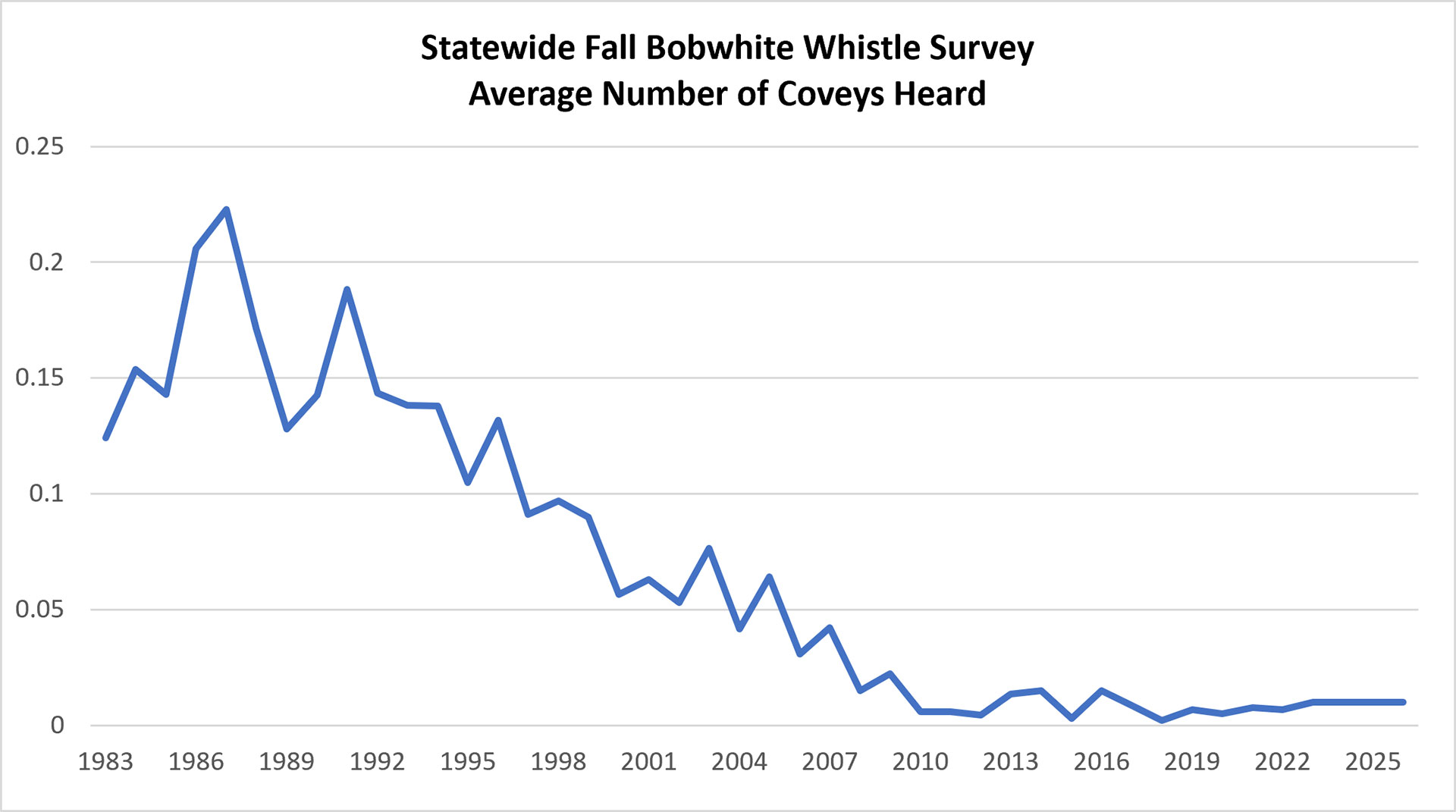
Any public-land quail hunter is by definition an optimist, and Frischhertz is experienced at looking for silver linings.
"We had a huge uptick out west in quail after Hurricane Laura back in 2020," he says. "It came through, and it really devastated the forest, but what it also did was provide escape cover throughout the forest. Some of that's still around; some of that's been burned. And if you put in the work, you're going to find birds. But you have to burn that boot leather for sure."
Smith says, "2026 seems to have been a fairly good year for bugs. I think just the little amount of rain that we have has definitely put us up ahead of where we've been since 2023."
"Even here at the house, we've seen an increase in frogs, which means that there's an increase in bugs," he continues. "So, I'm assuming that the same thing is going to apply in the pine trees all around my house where I've definitely heard more quail this year than in years past."
Top Spots
Cedotal reminds hunters that western Louisiana still has viable populations of bobwhite in parts of the Kisatchie National Forest and Fort Polk WMA, which, he says, "offer some decent quality habitat and hunting opportunity."
Frischhertz concurs with Fort Polk WMA but notes it is a military base, so he cautions hunters to be aware of area closures for training as well as dangers to dogs and humans, like razor wire left behind after training.
Insider Tips
Cedotal reminds anyone hunting bobwhite quail in Louisiana, "Scout for areas of good habitat, check regulations, be persistent, and manage expectations."
Frischhertz tends to hunt the western portion of Louisiana but lives near Baton Rouge. He has not been to his hunting grounds enough this year to comment on the broods there, but offered that in his region, "They definitely have some birds in the sugarcane fields. They're in the ditches and whatnot. My brother is a sugarcane farmer, and he manages about 15,000 acres. I don't shoot them, they're my training birds, but you can definitely go out there in the cane fields and be surprised by a covey or two."
Tall Timbers Game Biologist Dr. Dwayne Elmore says of the Southeast generally, "Public land options in the Southeast are still limited. There are large areas of public land that have the potential to produce good bobwhite hunting, but the few that exist are generally heavily hunted."
That's a fact in Louisiana, but supporting advocacy and legislative efforts like Quail Forever's is one way hunters will see public opportunities get better.
Season Details
Season Dates
Louisiana hunters can pursue quail from Nov. 21, 2026, to Feb. 28, 2027.
Daily Bag Limit
10 quail
Possession Limit
30 quail
Maryland
Quail Hunting Forecast 2026 - Maryland
Localized Strongholds Persist Despite a Difficult Year
By Gilbert Randolph, QF Bobwhite Communications Specialist
Weather and Conditions
Weather conditions for 2026 have been somewhat unpredictable. The 2025-26 winter brought severe weather and significant snow accumulation, followed by a drier-than-average spring. By August, the University of Maryland Extension reported the majority of the state was in severe or moderate drought. Recent rain events have helped lower drought levels in parts of the state, and it remains to be seen if more precipitation will continue or if Maryland will return to drought.
"The 2025-26 winter left many quail experts and enthusiasts unsure of the status of Maryland's bobwhites," says Jackson Hutchison, biologist for the United States Department of Agriculture's Natural Resources Conservation Service in Maryland. "Multiple weeks of snow covered by an inch of ice in much of the area was followed by moderate to severe drought through much of the spring and summer."
Despite the unfavorable weather, Hutchison says quail have been found across the Eastern Shore counties this summer.
"Whistling activity has been lower compared to last year, but birds have been widely reported in localized hotspots," he says.
For current drought conditions consult the U.S. Drought Monitor.
Habitat Conditions and the Chapter Perspective
Hutchison reports that "managed properties with an abundance of shrubby cover seem to have had more quail make it through the winter. Healthy brood sizes have also been reported, despite the lack of calls. It remains to be seen how the recent uptick in rainfall will impact later nesting females."
Maryland continues to have a moratorium on public-land quail hunting, but there will continue to be opportunity on managed private lands.
John Brader, president of the Chesapeake Bay Chapter of Quail Forever, is optimistic that the management work being accomplished on both public and private lands will have a positive impact on quail populations in the state.
"Additional strongholds persist primarily on Maryland's Eastern Shore and in Delaware, where large blocks of early successional habitat are actively managed for bobwhites, like Nanticoke WMA and other Maryland DNR-managed areas," Brader says. "Quail and other wildlife need habitat connectivity to expand their range, but these hubs of habitat are in place to provide the source of wild quail as nearby habitat is created."
The Chesapeake Bay Chapter has donated $53,000 over the past three years to plant nearly 500 acres of native grass and wildflowers at Brown's Branch WMA in Queen Anne's County. They continue to be energized and engaged in helping make habitat restoration and quail conservation a larger part of the conservation focus of the state.
Season Details
Season Dates
Maryland's quail season runs Nov. 7, 2026 — Jan. 15, 2027, on private lands east of the Susquehanna River and all lands west of the Susquehanna River, excluding Garrett and Allegany counties.
Hunters should check current Maryland regulations for the complete list of areas open to quail hunting before heading afield.
Daily Bag Limit
6 quail
Possession Limit
12 quail
Mississippi
Quail Hunting Forecast 2026 - Mississippi
A Mild Winter and Good Cover Bring Cautious Optimism
By Russell Worth Parker
Mississippi struggles to sustain and increase its wild bobwhite populations because of limited suitable habitat within the state, but this year could see a modest increase over last year. Properties where the best habitat management practices are implemented should see stable bobwhite populations, and overall, bird numbers appeared to be generally more abundant coming into winter compared to the previous year.
Quail Forever State Coordinator John Mark Curtis says, "There are more quail on the landscape than people really realize in Mississippi. It's definitely not like the good old days, but there's still a baseline population across most of the state that responds well to habitat being created."
Weather and Conditions
"Overall winter was pretty mild again this past year, with the exception of about a week of hard cold for our region in late January, where about a third of the state experienced a significant ice storm," says Rick Hamrick, Small Game Program Coordinator and Biologist for the Mississippi Department of Wildlife, Fisheries, and Parks. "We had radio-marked quail in one area that was hard hit with ice for several days, but they all survived that event. We had a very good acorn crop around much of the state last year, and food resources should have been good going into winter."
Hamrick does say 2026 was one of the driest springs he can recall.
"However, with just a few exceptions, we started getting abundant rainfall by late May on through early summer," he says. "Things started drying out by mid-July, and we are seeing the usual later summer rainfall pattern. Some areas are drier than others now, depending on how the afternoon thunderstorms go, which drives most of our rain events in late summer. Still, vegetation should be in good condition for cover and insect production in most of the state."
Curtis reports, "We had milder temperatures and not a lot of rain, so overwinter survival should have been really good. For this summer, it really wasn't just terribly hot until August. Weather conditions were a little milder. It started off really dry up until about May, and then we started catching some rain from there when there were some heavier rainstorms, which, depending on the timing, could have been an issue in select parts of the state for bobwhites."
"But overall, it's not been one of those summers where we've had weeks on end of over 100-degree weather," Curtis continues. "So, it should have been a pretty productive season for bobwhites."
Curtis is as bullish on forage as Hamrick.
"We had a bumper acorn crop, just out of this world, so there should have been a lot of food on the ground."
Todd Robinson is the general manager at B. Bryant Farms, a private, 3,700-acre ongoing wild quail effort in West Point, Mississippi. He reports that Mississippi did not "have a terribly harsh winter, and then we had a good spring with really good rainfall. I would say our birds came out of winter pretty good."
Habitat, Broods, and Counts
Hamrick reports, "We conduct breeding season quail call counts from selected Wildlife Management Areas. Looking at some of our typically ‘better' quail habitat Wildlife Management Areas, the numbers from call count surveys are pretty much the same this year. Some are up and some are down, as is usually the case."
"The 2026 range in these counts is about 0.7–1.6 male bobwhites heard calling per listening station, with a range of about 12–25 listening stations," he continues. "Like last year, it was hard for many areas to find good weather days to conduct counts during the survey timeframe, so I believe our call count results this summer were hard to gauge due to weather effects."
The report on trends is underway and should be complete by Oct. 1, 2026. When it is completed, it will be available here.
Curtis notes that the ice storm in far north Mississippi did cause some forest damage that "would have the potential to affect quail."
"It caused a ton of damage for people, but I guess one silver lining for bobwhites is a lot of that forest damage will create better conditions in the understory for bobwhites," Curtis says. "So, you know, even though it was a really bad thing, there may be an upside there from a quail perspective."
"Early on, I think we'll get a lot of herbaceous growth, but also there's the problem of all that additional woody fuel that now has to be dealt with, and it's going to make it harder to get in with fire to clean all that up," he continues. "So, I think in the short term, it'll be a good thing. In the long term, it'll be interesting to see how it plays out."
Curtis says the dry conditions also created opportunities for prescribed burning.
"Because it was so dry this summer, it was really good weather for prescribed burning, which would be really good for quail from a brooding cover and nesting cover perspective."
Regarding counts, Curtis says, "They started calling early this year. I started getting reports of quail calling in April. I know there's still some calling activity going on right now in August, though it kind of has gotten pretty hot on them here of late. So I'm optimistic that condition-wise, it should have been a decent summer for production."
Near West Point, Robinson is enthusiastic about habitat. He should be; he dedicates himself and his staff to it.
"We've got a lot of forbs, a lot of insects," Robinson says. "It was a good spring for brooding. My guys were seeing lots of chicks and lots of birds. I had a half a dozen encounters myself."
Top Spots
Hamrick suggests quail hunters visit Mississippi Wildlife Management Areas and National Forests in the Southwest, South Central, and Southeast WMA regions.
"Hunters should keep public land expectations modest," he notes, but adds, "We manage Charles Ray Nix WMA in northwest Mississippi with some emphasis on quail habitat."
Hamrick cautions hunters to "always consult regulations for open dates and special rules that may apply to a given WMA."
Insider Tips
As always, quail hunters in Mississippi should be prepared to cover a lot of ground to find birds, Hamrick advises. Quail will often move into thicker, heavier cover as winter progresses. They will use hardwood edges when acorns and other seeds are available. Working these areas within the vicinity of grass fields and more open woods with grassy ground cover, especially those that have burned within the last year, is typically more productive.
Woodcock are often found in many of the same areas as quail and can at times provide some additional bird contacts. Just be sure to have Harvest Information Program (HIP) certification for migratory birds on your license before pursuing woodcock.
Curtis says, "One of the best tips I ever got for wild quail hunting, particularly in Mississippi, is if you and your dog aren't bleeding, you're doing it wrong. Particularly in the winter, they're in thicker cover than people think they are."
"And they're in way thicker cover than people are used to hunting who hunt plantation birds," he continues. "You really have to work for wild birds. And you have to be willing to get off trail, and you have to be willing to beat the bushes."
Curtis says that type of hunting also requires a dog accustomed to handling wild birds.
"It takes a lot of work to get a dog to do that who's used to plantations. You've really got to run them on wild birds quite a bit."
Tall Timbers head quail biologist Dr. Dwayne Elmore says, "Public land options in the Southeast are still limited. There are large areas of public land that have the potential to produce good bobwhite hunting, but the few that exist are generally heavily hunted."
Elmore also reminds hunters that management agencies need to hear from bird hunters about making active thinning and an increase in patchy prescribed fire a priority on public lands.
Season Details
Season Dates
Mississippi quail season runs from Nov. 26, 2026, to March 7, 2027.
Daily Bag Limit
8 quail
Notes
A WMA User Permit is required to hunt a WMA unless the hunter is exempt from purchasing hunting and fishing licenses altogether.
Pen-raised quail may be hunted on private land during the state's quail season, though the same bag limits apply unless a hunter has a shooting preserve license or dog-training permit that allows exceeding bag limits.
For information on quail hunting, email Rick Hamrick at rick.hamrick@wfp.ms.gov.
Missouri
Quail Hunting Forecast 2026 - Missouri
Good Habitat Has Missouri Quail Hunters Optimistic
By Gilbert Randolph, QF Bobwhite Communications Specialist
Quail Numbers
The Missouri Department of Conservation estimated 1.68 quail per 30 miles of roadside survey route in 2025. This represents a 20% reduction from 2024, though the picture varies by region. The north-central and northwestern parts of the state saw between a 13-40% decrease in quail observations, but the northeastern as well as west- and east-central portions of the state saw increases in observations.
Areas that have prioritized upland habitat restoration, such as the Quail Restoration Landscapes, have shown that quail respond positively to habitat work, especially when they have a mosaic of private and public land where their cover, foraging and nesting needs are being met in close proximity.
The 2026 roadside surveys are still being analyzed, but information on quail counts will be available through the Missouri Department of Conservation, typically before the quail opener on Nov. 1. When they become available, they can be found here.
Weather and Conditions
Missouri recorded its 16th-wettest spring this year, breaking the years-long pattern of drought conditions throughout most of the state. Southeast Missouri remains below average for rainfall, however. Despite heavy rainfall during the spring, the outlook for quail is positive, particularly in areas where good-quality habitat remains.
"The heavy rains that hit in the early nesting season were cause for concern initially," says Andrew White, Missouri senior state coordinator for Pheasants Forever and Quail Forever. "However, in areas with moderate- to high-quality habitat, the weather has not been as concerning. I've heard reports of numerous and large broods of varying maturation, and I am confident that we will see another good year for the birds."
White notes that some parts of Missouri did experience prolific flooding.
"Some areas of the state did see catastrophic flooding, so bird numbers will obviously be quite low in those areas," he says. "Areas hit hardest with flooding events have been south of I-70."
"We had a few rough spells during winter with very frigid temperatures and some snow events, but nothing too severe," says Beth Emmerich, quail and upland game biologist for the Missouri Department of Conservation. "Spring started off wetter the further north in Missouri you went and much drier in central and southern Missouri."
"Summer brought variable rainfall patterns throughout the state," Emmerich continues. "North Missouri has been near normal with central Missouri fairly wet, then drier the further south you go. June was fairly wet in southern Missouri with higher-than-normal rainfall, while July had much lower-than-normal rainfall events."
Despite that variability, Emmerich remains optimistic.
"We feel that production should have been good, unless the drier weather currently is impacting insect abundance in southern Missouri," she says. "We feel optimistic that production should be good this year."
The Chapter Perspective
Steve Meyer of Chapter 707 Northwest Missouri Longtails reports that despite the rainfall, he's seen plenty of birds on his 120 acres. He has focused on reducing woody encroachment, prescribed burning and creating escape cover close to food sources.
"I've had them run out in front of me in the fire lanes and in front of my tractor," Meyer says.
When asked what sort of habitat features hunters should focus on in the upcoming season, Meyer says, "As far as hunting goes, I would recommend people look for downed tree structure and cover that they use to escape predators."
Quail Forever chapters across the state have been involved in habitat workdays and continue to improve both public- and private-land habitat for upland birds.
Public Access
Missouri has a significant amount of public hunting ground available for upland birds. MDC-managed lands with upland opportunities can be found through the department, and it's important to check area regulations for each piece of MDC-managed land.
U.S. Army Corps of Engineers, U.S. Fish and Wildlife Service, leased public land, and National Forest land are also available for public hunting, and these areas often operate under broader statewide regulations. Many areas require nontoxic shot, so check ammunition requirements before you go.
Thanks to the Build a Wildlife Area program, Quail Forever has added 903 acres of publicly accessible grassland habitat to the state. These properties have been transferred to the Missouri Department of Conservation for management and are open to public quail hunting.
Upland hunters can also utilize the MDC website to help locate potential quail hunting opportunities on MDC-managed conservation areas.
Looking to find like-minded hunters who are passionate about the uplands and conservation? Getting in touch with a local Quail Forever chapter is a great way to meet new hunting buddies, get involved in local volunteer efforts and contribute to upland conservation in your local community.
Habitat Remains the Key
Thanks to the memorandum of understanding (MOU) between Quail Forever and the Missouri Department of Conservation, Quail Forever staff and volunteers can assist with habitat improvements on MDC-managed lands throughout the state.
Now in the second year of the agreement, Quail Forever volunteers have helped conduct prescribed burns, combat woody encroachment, remove invasive species, and more.
As hunters head afield, places with good escape cover close to reliable food will be productive spots to focus. Brush up on plant identification and be able to recognize areas with food sources such as ragweed, beggar's lice, or partridge pea.
Season Details
Youth-Only Season: Oct. 24 — 25, 2026
Daily Bag Limit: 8 quail
Possession Limit: 16 quail
The youth-only season is open to hunters ages 6 through 15. Youth hunters who are not hunter-education certified must hunt in the immediate presence of a properly licensed mentor; however, the mentor may not hunt quail.
Regular Season: Nov. 1, 2026 — Jan. 15, 2027
Daily Bag Limit: 8 quail
Possession Limit: 16 quail
Nebraska
Quail Hunting Forecast 2026 - Nebraska
Nebraska Bobwhites Continue Their Climb
By Ryan Sparks, Quail Forever Journal Editor and Native Husker
Nebraska quail hunters have a good reason for optimism heading into the 2026 season. After a noticeable increase in birds last year, nearly every available measure suggests the state's bobwhites have taken another step forward.
A mild winter helped carry good numbers of birds into spring, while timely moisture improved nesting and brood-rearing habitat across much of the state's core quail range. Spring whistle counts increased from 2025 and exceeded both the five- and 10-year averages. Then came the July Rural Mail Carrier Survey, where statewide quail counts jumped 134% from last year and finished 50% above the 20-year average.
Add frequent reports of good-sized broods, and Nebraska appears poised for one of its better quail seasons in recent memory.
Habitat Conditions
Nebraska's most well-known quail areas are heading into fall with some of the best habitat in years.
The groundwork for this season was laid in 2025. After several years of drought, summer moisture returned to much of the state and produced strong grass growth. Drought and wildfires have also reduced cattle numbers on some rangelands, leaving more residual cover heading into this year's nesting season.
"In native rangelands, our dry conditions from 2024 and 2025 forced many ranchers to reduce their livestock herds," says Ben Wheeler, a Nebraska-based coordinating wildlife biologist with Quail Forever. "Meanwhile, the grass keeps growing with fewer cattle to feed. Native grassland birds like bobwhites can thrive on healthy, productive rangelands."
This spring started dry across much of Nebraska, but moisture beginning in June improved conditions throughout most of the quail range. The Nebraska Game and Parks Commission reports that those timely rains helped maintain good nesting and brood-rearing habitat, particularly across southern and eastern Nebraska.
In southeastern Nebraska, the results have been especially noticeable.
"In my time as a biologist, some of the best habitat conditions I've seen have been from this spring and summer," says John McClinton, a Nebraska senior Farm Bill biologist with Quail Forever. He credits the return of moisture following prolonged drought and bare-soil conditions for "an explosion in floral and insect diversity."
Justin Carmona, Quail Forever's Nebraska Bobwhite Quail Habitat Coordinator, agrees.
"I had walked quite a few CRP fields this summer and a very large number of them had great floristic diversity and good quality native grasses," Carmona says.
Ironically, some lingering effects of drought may also be helping broods. Wheeler says drought can check thick grass stands, opening bare ground and encouraging annual weeds.
"In drought thick grasses get checked, opening up bare ground and annual weeds – great areas of stress-free travel for pre-flight broods and havens for soft-body insects that broods will devour," he says.
There were localized severe storms, including hail and heavy rainfall, that may have affected individual nesting attempts. Carmona mentioned several severe thunderstorms with large hail in southeastern Nebraska, but those storms were not widespread enough to make a large impact and occurred early enough that birds should have had time to renest. Nebraska Game and Parks reports continued male calling and observations of paired adults well into summer, which are both indicators of additional nesting attempts.
Quail Numbers
Statewide whistle counts increased from 2025 and finished above both the five- and 10-year averages. Nebraska Game and Parks reports that all management units except the Northeast and East Central showed increases in spring whistle counts.
The July Rural Mail Carrier Survey was even more encouraging.
Statewide counts increased 134% from 2025, putting this year's index 13% above the five-year average and 50% above the 20-year average.
The East Central, Republican, and Southeast management regions are expected to hold the state's highest quail densities this fall.
East Central comes out on top in surveys for overall numbers, with Seward and Thayer counties also highlighted by the Nebraska Game and Parks. Despite a 14% decline from 2025 in the July survey, the region remains 36% above its 20-year average.
The Republican region ranks second and recorded a 176% increase from 2025. Red Willow, Furnas, and Harlan counties are among the region's top bets.
The Southeast ranks third but may offer some of the most encouraging numbers in the state. July counts increased 102% from last year and sit 28% above the 20-year average. Gage, Jefferson, Johnson, and Pawnee counties are all highlighted by Nebraska Game and Parks.
Carmona's observations reinforce those numbers.
"I can't speak for the entire state, but quail numbers are very good in the Southeast," he says. "They are still much lower than they were 50 years ago. But we are doing some good work throughout the area."
On one whistle-count route this spring, Carmona recorded roughly 10 more unique whistling males than the average from previous years.
McClinton has noticed the same trend while working throughout southeastern Nebraska and portions of the eastern Rainwater Basin.
"Anecdotally, being in the field doing status reviews, the number of whistling bobs was very encouraging, and this has been the case for a few years in a row now," he says.
Good news isn't limited to the traditional strongholds. West Platte increased 521% from 2025, while the Northeast increased 387%. The North Central region increased 12%. However, Game and Parks cautions that large percentage increases in lower-density regions may not translate into equally dramatic changes in hunting conditions and could be impacted by small, localized populations.
Still, Bryan O'Connor, Upland Game Program Manager for the Nebraska Game and Parks Commission, sees reason for optimism throughout the range.
"Quail look good range wide," O'Connor says. "Strongest numbers are going to be in the South Central and Southeast."
Access
Nebraska remains more than 97% privately owned, but hunters have more than 1.3 million acres of public and privately owned land open to public hunting across the state. Those properties can be found in the annually updated Nebraska Public Access Atlas.
In the Southeast, wildlife management areas in the southern two tiers of counties offer some of the region's best opportunities. Many are managed specifically with quail in mind, and in an otherwise fragmented landscape they provide some of the largest contiguous blocks of bobwhite habitat available to hunters. Open Fields and Waters properties scattered throughout the region should not be overlooked, just make sure they are open to hunting. Some Open Fields and Waters properties are only open for fishing.
Carmona recommends using the Public Access Atlas to identify Open Fields and Waters properties containing CRP, then scouting those tracts for the right combination of grass, forbs, and shrub cover.
Moving west along the Kansas border, hunters should concentrate on CRP edges, unfarmed draws, and crop stubble. Nebraska Game and Parks mention in their Hunting Outlook that some of the best quail hunting is generally found east of U.S. Highway 83. WMAs and U.S. Army Corps of Engineers properties surrounding irrigation reservoirs also provide large blocks of habitat worth exploring.
Hunters should be aware of Nebraska's growing Nebraska Community Access Partnership (NCAP), which uses Pheasants Forever and Quail Forever resources to help expand public access on private lands. Wheeler points to NCAP as an increasingly important addition to the state's existing Open Fields and Waters opportunities. This program is one of the most promising developments for Nebraska hunters in many years.
Finally, Nebraska's new Stubble Access Guide is a useful supplement to the Public Access Atlas, highlighting additional crop stubble and associated habitat enrolled for public hunting.
Overall Hunting Prospects
It is difficult to find much bad news for Nebraska quail this year.
A mild winter produced good carryover. Habitat across most of the core range benefited from timely summer moisture. Spring whistle counts were above recent averages. Brood reports have been frequent, with good-sized broods reported. And the July Rural Mail Carrier Survey increased dramatically from both last year and the long-term average.
There will still be considerable variation from one property to the next. Localized hail and severe storms affected portions of the state, while emergency haying and grazing could alter cover on some CRP properties. Preseason scouting remains important.
If a traditional spot doesn't look right this fall, Wheeler suggests using it as an excuse to explore.
"At worst, you get to polish off those skills of how to evaluate a new area," he says. "At best, you just landed on a new hot spot to revisit in upcoming years."
The Southeast, East Central, and Republican regions remain Nebraska's best known quail country, but this year hunters could find coveys beyond the state's traditional hotspots.
After several lean years followed by noticeable improvement in 2025, Nebraska's bobwhites appear to have built on that momentum in a big way. The 2026 season could be one Nebraska quail hunters remember for a long time.
Season Details
Season Dates
Pheasant, quail and partridge: Oct. 31, 2026 — Jan. 31, 2027
Notes
Hunters should consult the Nebraska Game and Parks website for current regulations and public-access information.
Nevada
Quail Hunting Forecast 2026 - Nevada
Drought and Heat Put Nevada Quail to the Test
By Gilbert Randolph, QF Bobwhite Communications Specialist
Nevada offers a broad range of upland opportunities for hunters, with seasons available for Gambel's quail, California quail, mountain quail, chukar, and Hungarian partridge. With challenging weather conditions a few years running, quail are currently constrained by available forage and habitat.
Weather and Conditions
This year is shaping up to be a hot one for Nevada. Record temperatures in the southern portion of the state have topped 110 degrees. At the time this report was written, the U.S. Drought Monitor reports that almost the entire state of Nevada is in either moderate, severe, or extreme drought.
"For both northern and southern Nevada, we are anticipating moderate to severe drought conditions extending through summer and into early fall," says Justin Small, Upland Game Staff Specialist for the Nevada Department of Wildlife Game Division. "These conditions will cause senescence of important vegetation communities that mountain quail, California quail, and Gambel's quail rely on in their respective habitat types, in turn reducing the overall habitat quality and availability across the landscape."
As with all the southwestern states, the availability of water will affect year-to-year quail numbers.
"With preliminary observations from regional biologists, we are expecting a bit lower recruitment compared to last season," Small says. "To that point, in late June 2026, the Wildlife Commission approved quail seasons to start one week later (October 17, 2026–February 7, 2027) for Fall 2026."
"By pushing back the season opener a week later, our hope is to remove some early hunting pressure when birds are compressed to free water sources and allow coveys to disperse once cooler weather appears."
Conservation Work
Quail Forever Nevada has been working with the Nevada Department of Wildlife Game Division to monitor the translocation of California quail into a mountain range in central Nevada. The monitoring effort used 12 cameras set out for four weeks, capturing more than 110,000 images that will be analyzed for quail activity.
So far, some of the translocated quail have been seen on the camera traps and are believed to have successfully nested and hatched a new brood.
The Chapter Perspective
"Valley quail populations in northern Nevada can vary greatly due to the vast range in habitat across the region. Areas with already well-established populations had favorable conditions last season," says Northern Nevada Quail Forever Banquet Chair Chris Verrue. "A mild winter followed by decent spring precipitation provided ample vegetation growth and an early green-up. These conditions provided good forage availability for chicks and provided quality nesting conditions as well."
Verrue says one of the negative impacts on valley quail in northern Nevada is the loss of prime habitat, mainly due to overdevelopment and fires.
"On a positive note, several reports observed birds having produced second hatches, which will hopefully make for better numbers going into the colder months," he says. "Overall, the combination of a mild winter, spring moisture, and favorable nesting conditions seem to be in favor for valley quail in parts of northern Nevada this season."
Hunting Tips
Hunting early season, particularly in southern Nevada, can be brutal due to the heat.
Lauren Stamm, Quail Forever volunteer and upland enthusiast, prefers to wait to hunt until cooler temperatures settle in. For those itching to get out on the season opener, she recommends hunting early in the day and making sure to pack plenty of water and electrolytes for you and your dogs.
In addition to the heat, Stamm warns that during the early season there's still a high risk of snakes being out and that it's good to be aware of this and plan accordingly.
When asked what areas to focus on, she says, "Water sources are important, but it's not always a spring or something known on a map. Prickly pears and other cactus-choked areas can be a good place to focus if your dogs are accustomed to hunting these areas."
Focusing on the northern part of the state, Hayden Shaw, Quail Forever Southwest Regional Representative, recommends starting with the state wildlife management areas.
"The Department of Wildlife spends a lot of time managing these lands for a variety of species, and quail benefit from almost every project and field planting," Shaw says. "Be sure you bring a comb, because if you're running a long-coated dog, there will be plenty of cleanup to do at the tailgate check. Stick to the field edges where the cover is too thick for you to get through, but that's where the birds like to hang out."
Shaw recommends knowing where the closest vet is to the area you're hunting before you go. Just as in the southern part of the state, snakes are still active early in the season in the northern counties. Hidden, downed barbed wire can ruin a good day in the field and send you to the vet for stitches or staples as well.
"Bring a good bird dog with you," Shaw says. "Their noses are a heck of a lot more effective than any of our senses and, almost always, add another enjoyable hunting partner to share the field with."
Shaw also reiterates the need to bring lots of water.
"I typically run two dogs at a time, and I never leave the truck with less than 5L of water for the dogs and 1L for myself," he says. "It will weigh you down a bit, but no one wants to run out of water out there for dogs or human consumption."
Season Details
Youth Quail Season
Sept. 26 — Oct. 4, 2026
California Quail: Daily Limit of 10 and possession limit of 30
Gambel's Quail: Daily Limit of 5 and possession limit of 15
General California and Gambel's Quail
Oct. 17, 2026 — Feb. 7, 2027
California Quail: Daily Limit of 10 and possession limit of 30
Gambel's Quail: Daily Limit of 5 and possession limit of 15
Limit singly. Hunting Hours: Sunrise to sunset. Open to nonresidents.
General Mountain Quail
Oct. 17, 2026 — Feb. 7, 2027
Daily limit of 2 and possession limit of 6
Youth Chukar and Hungarian Partridge
Sept. 26 — Oct. 4, 2026
Daily limit of 6 and possession limit of 18
Chukar and Hungarian Partridge
Oct. 17, 2026 — Feb. 7, 2027
Daily limit of 6 and possession limit of 18
Notes
Find more detailed regulations here. Always check local regulations before heading afield.
New Mexico
Quail Hunting Forecast 2026 - New Mexico
Better Moisture Offers Hope, but Quail Prospects Remain
By Brad Trumbo
New Mexico is one of only four states that is home to four quail species – northern bobwhite, Gambel's, Montezuma (Mearns), and scaled – inhabiting a uniquely beautiful landscape. What's more, intriguing natural wonders like Carlsbad Caverns, White Sands – 275 miles of pure white gypsum dunes – and the volcanic remnants of hoodoos and badlands bookend legendary quail hunting.
Overall, hunters can expect an average quail year across much of the state, though prior years of low reproduction continue to affect Mearns quail in the south and west.
Weather and Conditions
New Mexico has experienced drought of varying degrees across the state for several consecutive years, and much of the state was abnormally dry to experiencing moderate drought conditions as of August this year. Good news — the southeast corner and western edge of the state experienced near-normal precipitation.
"The southwest continued to be dry, though the area did receive some precipitation during January and February, when moisture is particularly important for Gambel's quail reproduction. Habitat is looking better than 2025," says Casey Cardinal, resident game bird biologist with the New Mexico Department of Game and Fish.
John Sherman, retired Bureau of Land Management wildlife biologist and quail enthusiast, confirms that the western side of the state received rain.
"A little late, but it may help the Gambel's and scaled quail."
While summer precipitation was better, extreme heat was another concern for broods.
"It has been very hot, with many days over 100 degrees. This can be detrimental for chicks when they are young and vulnerable," Cardinal says.
Sherman agrees.
"If they can make it until the temperature drops off, they're good to go," he says.
For current drought conditions, consult the U.S. Drought Monitor.
Quail Numbers
The prior two seasons saw a reduced harvest for nearly all species. Scaled quail harvest was slightly better in 2025 than 2024, averaging 9.1 birds per hunter, primarily in the eastern part of the state, according to voluntary harvest reports. Gambel's and Mearns harvest was significantly lower in 2025 than in 2024.
"Quail hunters across the western portion of the state reported that quail were very challenging to find and that covey sizes were smaller and more infrequent," Cardinal says.
Conversely, Sherman reported good numbers of scaled quail in the southeast corner last year. Similarly, Cardinal reported good adult carryover from 2025 and fair habitat conditions for reproduction in eastern New Mexico.
Cardinal also anticipates slightly better Gambel's and Mearns production this year compared to 2025 but cautions that "…it's still not a great year."
Overall Hunting Prospects
New Mexico quail hunters should expect an average season in 2026 for scaled and Gambel's quail, and slightly below average for Mearns. The western edge of the state and southeast counties have benefited from rainfall, good adult quail carryover, and adequate habitat conditions.
Cardinal and Sherman both reported that bobwhites may be patchy in the southeast this year. Scaled quail remain widespread, but hunters should key in on areas with good forb and shrub diversity.
If You Go
Season Dates
The 2026 - 27 New Mexico quail season runs Nov. 15, 2026, to Feb. 15, 2027.
Notes
The daily bag limit is 15 quail of a single species or aggregate, with no more than five Mearns quail. The possession limit is 30, with a maximum of 10 Mearns quail.
A game-hunting license is required, with a junior license available for hunters under 17. A habitat stamp is required for U.S. Forest Service and Bureau of Land Management lands unless exempted as a 100% disabled resident veteran.
Quail are broadly distributed but rarely overlap. Scaled quail occur in nearly every county. Gambel's are found in the southwest and range north into Sierra and Taos counties. Montezuma quail inhabit the southwest and south-central mountains. Bobwhites are limited to the eastern border counties.
Hunters should be mindful of cactus, rattlesnakes, mesquite thorns, and rocky soils. Running dogs after New Year can reduce snake encounters. Dog boots are recommended to protect paws, and a comb is essential for cactus removal in the field.
North Carolina
Quail Hunting Forecast 2026 - North Carolina
Drought Raises Concerns, but Good Habitat Still Holds Birds
By Rachel Holt, QF Regional Communications Specialist
Summary of Last Year's Birds and Current Bird Numbers
North Carolina's 2026-27 quail outlook is a mixed bag. While some well-managed properties continue to produce huntable coveys, prolonged drought during the spring and summer has raised concerns about nesting success and brood survival across much of the state. Wildlife biologists and quail managers expect bird numbers to be stable to lower in many areas, with the strongest hunting opportunities likely to remain concentrated on properties where quality early-successional habitat has been maintained.
The 2025-26 season was generally comparable to recent years. Hannah Plumpton, upland game bird biologist with the North Carolina Wildlife Resources Commission (NCWRC), said results from the agency's Avid Quail Hunter Survey were "on par with the past few years."
Jacob Comer, North Carolina Quail Forever state coordinator, likewise said last year's bird numbers were generally what hunters would expect on properties managed for early-successional habitat. While numbers were not robust, those properties still provided opportunities to move coveys.
Theron Terhune, who works for Orton Plantation and previously worked with Tall Timbers, described the 2025-26 season as "a relatively goofy year for wild quail in North Carolina," particularly across portions of the Coastal Plain and Piedmont. Reported hunting success varied considerably, from roughly one covey moved every three hours to as many as four coveys per hour, with the best results occurring on intensively managed private lands.
The outlook for the coming season, however, is less encouraging.
Weather and Habitat Conditions
One of the biggest challenges this year has been drought. Much of North Carolina experienced drought conditions from spring through mid-summer, with a large portion of the state reaching severe or extreme drought levels. Late-summer rains provided some relief, although they also produced localized flooding.
Plumpton said the prolonged drought is "not encouraging in terms of quail reproduction."
"The lack of vegetative cover for nests and low insect abundance suggest this will be a low reproductive year," Plumpton said.
Comer similarly noted that the drought likely reduced nesting success and brood survival in some areas, particularly where habitat quality was already limited. Timely rainfall during the growing season may have helped offset some of those effects on better-managed properties.
The state's overall supply of quail habitat remains a larger, long-term concern. Forest maturation, development, declining timber markets and the loss of early-successional cover continue to reduce suitable habitat. Targeted conservation work on private lands, working farms and managed pine landscapes, however, continues to create pockets of high-quality habitat.
Properties that maintain diverse early-successional habitat with nesting cover, brood habitat and escape cover should be better positioned to produce coveys this fall.
Winter weather also played a role. A significant snowstorm affected the Piedmont in January, with snowfall reaching as high as 16 inches in some locations. Comer said the event likely caused some localized winter mortality, particularly where escape cover was lacking.
Terhune also pointed to multiple winter weather events as a potential source of reduced overwinter survival. Snow remained on the ground for several days in some areas, potentially limiting access to natural foods and increasing the energetic demands placed on birds.
Still, the winter's effects should not be overstated. Comer emphasized that fall quail numbers will be influenced more heavily by habitat quality and spring and summer nesting success than by the January snow. On properties with strong habitat, reproduction may offset winter losses.
Where to Find Birds
For hunters, North Carolina's best opportunities remain tied to the places where habitat management is producing the right combination of cover and food.
Comer recommends starting with NCWRC-owned Game Lands from the Piedmont through the Coastal Plain. Hunters should also look for specific permit-hunting opportunities. Military lands can provide additional options, including Fort Bragg in the Sandhills and Camp Lejeune along the coast.
National Forest lands such as the Uwharrie in the Piedmont and Croatan on the coast can also provide opportunities for hunters willing to scout.
Terhune cautions that wild quail on public lands can be highly variable. Hunters should expect different birds depending on where they hunt. Numbers and covey sizes vary from one property to another, and hunters should use NCWRC Game Lands mapping resources (see the link above) to identify potential areas before heading afield.
Across both public and private land, recent habitat work is the best clue. Hunters should focus on areas with young forest, recently thinned pine stands, and other early-successional cover. On private lands, intensively managed properties can produce better hunting than surrounding areas.
Statewide conditions may point toward fewer birds, but a hunter walking into a well-managed property could experience something very different.
For hunters willing to scout, the best strategy is to look for the habitat first and birds second. In a year when reproduction may have been suppressed by drought, finding those pockets of quality cover could make all the difference.
For current drought conditions, see the U.S. Drought Monitor.
Season Details
Season Dates
North Carolina's 2026-27 quail season runs from Nov. 21, 2026, through Feb. 28, 2027.
Daily Bag Limit
6 quail
Possession Limit
12 quail
Notes
A valid hunting license is required, and additional Game Lands regulations may apply. Permit-only opportunities are available on some properties, including Voice of America Game Land, with applications due Oct. 1, 2026.
Hunters should check current NCWRC regulations for specific Game Land restrictions and license requirements before heading afield.
Ohio
Quail Hunting Forecast 2026 - Ohio
Winter Knocked Ohio's Quail Back, but Coveys Remain Across the Range
By Brian Rhodes, Communications Specialist
Ohio's northern bobwhites were coming off their strongest whistle counts in five years when a late January storm buried the state under snow and ice and kept it there. Spring counts came in 40% lower.
The birds that had the right cover appear to have come through. Coveys still hold across all 16 southern counties open this fall, though hunters will walk farther between flushes than last season.
Weather and Conditions
Winter decides Ohio quail seasons, and this one arrived all at once.
"A major winter storm hit Ohio, and much of the country, in late January 2026, which brought a lot of snow and ice in some cases, to most of Ohio (6-18 inches)," said Cody Grasser, Ohio state coordinator for Quail Forever and Pheasants Forever. "On top of that, it brought a deep freeze that lasted over a week, with daily temps and/or windchills staying near or below zero. The following week warmed up to the teens and twenties but did not do much to melt the snow and ice."
The storm stacked up worse where the birds live.
"In much of southern Ohio quail range, we received several inches of snow, followed by an ice storm (which created an inch or more of ice on top of the snow in some cases), followed by an additional couple inches of snow," said Scott Carpenter, a Farm Bill biologist with Quail Forever. "This, along with the long period of cold, created very challenging conditions for quail."
Spring flipped the pattern. March through May brought widespread rain, and southern Ohio picked up 8 to 10 inches in June before things turned dry in late July.
Quail Numbers
Ohio entered winter in good shape.
"In 2025, whistle counts were among the highest in the past 5 years," said Joseph Lautenbach, a wildlife biologist with the Ohio Division of Wildlife.
Quail Forever's acoustic recorders picked up quail in all 12 southern Ohio counties where the organization deployed them.
"In Ohio, quail are tracked through annual whistle counts conducted from mid-May through the end of June," Lautenbach said.
This year's came in hard.
"Following a harsh winter, the 2026 spring whistle counts were 40% lower than last year," he said.
Winter has done this before, and worse. The state once held an estimated 7 million quail. Blizzards in the winters of 1976-77 and 1977-78 killed roughly 85% and 80% of them, and the population bottomed out near 430,000. It never recovered.
The view from the field is more hopeful.
"I'm cautiously optimistic about bird numbers following reports this spring from several landowners who were seeing and hearing birds in areas that were impacted by the storms," Carpenter said.
Access
Ohio's county list and its public-land list are two very different things, and the gap catches out-of-state hunters every year.
"Go to the regulations book first, since quail hunting is closed in many counties and all public hunting areas," Grasser said.
Sixteen southern counties allow quail hunting on private land. Public ground comes down to two properties.
"Quail hunting in Ohio is closed on all public grounds, except controlled hunts on the Crown City Wildlife Area (which application has now closed), and the Tri-Valley Wildlife Area in Muskingum County, which is outside of the main 16 counties that are open on private land," Carpenter said.
That makes Tri-Valley, roughly 15,000 acres near Dresden, the only public ground in Ohio a hunter can walk onto without a permit.
Everywhere else, private land is the game. OLHAP, Ohio's walk-in access program, just landed a $3 million federal grant to expand and already covers about 200 properties across 51 counties. Permits are free.
Habitat is moving too.
"It was a big year for CRP enrollment, which could result in some new habitat being established and some existing acres being enhanced through the re-enrollment process," Grasser said. "On top of that, a new Wildlife Habitat Initiative funded by NRCS's RCPP became available to private landowners last year and is helping to improve habitat for quail."
The winter also left a lesson about where to look.
"Winter storms like this really highlight the importance of good thick, shrubby winter thermoregulatory habitat," Carpenter said.
Overall Hunting Prospects
The whistle counts call this a step-back year. The birds are still spread across the range, which is encouraging.
"Quail can be found in dispersed, small populations across all the 16 open counties in southern Ohio; however, numbers continue to be low," Carpenter said. "Scouting, talking with landowners and finding good early successional habitat is key to finding birds."
The longer view is harder.
"Overall, quail habitat is likely decreasing," Lautenbach said. "However, Ohio Division of Wildlife, Pheasants Forever and Quail Forever, and other conservation partners continue to work to promote, sustain, improve, and create quail habitat on both public and private lands."
Season Details
Season Dates
General Season: Nov. 6 — 29, 2026
Youth Season: Oct. 24 — 25, 2026, and Oct. 31 — Nov. 1, 2026
Limits
2 northern bobwhites daily
Field possession limit also 2
Notes
Open Counties, Private Land: Adams, Athens, Brown, Butler, Clermont, Clinton, Highland, Jackson, Meigs, Montgomery, Pike, Preble, Ross, Scioto, Vinton and Warren
Public Land: Tri-Valley Wildlife Area in Muskingum County and controlled hunts at Crown City Wildlife Area in Gallia and Lawrence counties. Closed on all other public areas.
Landowners interested in grassland habitat can contact an ODNR wildlife management consultant or a Quail Forever Farm Bill biologist at no cost.
Oklahoma
Quail Hunting Forecast 2026 - Oklahoma
Strong Carryover Has Oklahoma Bobwhites Positioned for Another Good Year
By Brad Trumbo
Oklahoma bobwhites continue to stand strong. Bobwhites occur throughout the state, with scaled quail occurring in the Panhandle. The varied habitats and terrain across the state make for exciting, scenic hunting and a beautiful landscape to watch a bird dog work its magic.
Weather and Conditions
"It's been hot, 100-plus degrees for weeks and not much rain," said Mike Ford with the Homesteaders Quail Forever Chapter.
"We're seeing the impact of drought primarily in the western half of the state, with now 99% of the state in some level of drought," said Tell Judkins, upland game biologist with the Oklahoma Department of Wildlife Conservation.
But drought conditions may turn around, thanks to the forecasted "Super El Niño."
"El Niño usually means milder temperatures and increased precipitation," Judkins said. "The last ‘Super El Niño' we experienced happened to be in 2015, which was also our last recorded ‘boom' year, so I am anxious to see what our upcoming surveys show."
For current drought conditions, consult the U.S. Drought Monitor.
Quail Numbers
Oklahoma quail populations are generally doing well. The 2025 October roadside quail survey showed statewide quail numbers holding strong at 4.54 quail per route, barely below the long-term average of 4.75 quail per route and 70% above the 10-year average of 2.67 quail per route.
Regionally, Northwest, Northcentral, and Southeast Oklahoma were above their respective long-term averages.
"Our 2025 surveys in Oklahoma saw a ~68% increase over '24; the fifth consecutive year observing our statewide population index going up!" Judkins said. "The Northwest, Northcentral, and Southeast regions came in above the long-term average for the first time in 8, 8, and 18 years, respectively."
Populations in Southeast Oklahoma have been below the 10-year and long-term averages since 2007. The years 2021-2024 saw extremely low numbers, but 2025 roadside survey results showed 4.63 quail per route – much higher than the region's 10-year average of 1.73 quail per route and slightly above the long-term average of 3.57 quail per route.
While adequate precipitation at the right time influences quail populations, the conservation efforts by Quail Forever and Pheasants Forever, along with their many local partners, are certainly part of the 2025 success in Oklahoma. Chapter efforts are a much-needed boost and rebuilding opportunity for bobwhite populations across the state.
Overall Hunting Prospects
2025 was clearly a good year for Oklahoma bobwhites, and the 2026 prospects are looking good.
"Nesting season appeared to be OK judging by the number of young birds and mixed ages of coveys being seen," Ford said.
"I've been hearing reports from around the state (including areas affected by drought) of good early season nest success," Judkins said. "We will again be monitoring the state with August and October roadside surveys. The August report is published in September, and the October report is usually published in the first week of November."
Scaled quail opportunities are limited to the Panhandle but persist where cover is available.
If You Go
According to roadside surveys, the Northwest region has consistently reported higher counts since 2017.
The Oklahoma quail season runs from Nov. 14, 2026, through Feb. 15, 2027, with a daily limit of 10 birds and a possession limit of 20 after the first day.
Shooting quail on the ground – known locally as "pot shooting" – is illegal.
Resident and nonresident quail hunters must purchase an annual hunting license or an annual combination hunting/fishing license. The nonresident five-day hunting license is not valid for quail hunting.
Nonresidents should plan ahead, as all WMAs in the western third of the state are closed to nonresident hunting from Feb. 1–15. Private land enrolled in the Oklahoma Land Access Program and federal lands remain open to nonresidents through the end of the regular season.
"Get out there! Work some ground, trust your dogs, and make a memory enjoying the Oklahoma outdoors!" Judkins said.
Nonresident Game Bird Permit
A nonresident game bird permit was introduced in 2025 and is required for any nonresident hunting game birds on Wildlife Management Areas (WMAs) or related public lands, including GMAs, PHAs, WRPs, WDUs and WMUs. The game bird permit is a separate $100 fee in addition to the standard nonresident hunting license ($209).
Land Access Permit
A land access permit is required for residents and nonresidents of any age utilizing Oklahoma Land Access Program (OLAP) properties. The land access permit is a separate $200 fee for nonresidents and $100 for residents.
Mandatory Check-in / Check-out for Nonresidents on Public Lands / WMAS
Mandatory check-in / check-out for nonresident hunters on public lands was also introduced in 2025. Nonresidents accessing certain public lands, including WMAs, are required to check in and check out via an online system. Oklahoma residents are not subject to this check-in requirement.
Hunters should consult current Oklahoma Department of Wildlife Conservation regulations for complete license, permit, access and season requirements.
Oregon
Quail Hunting Forecast 2026 - Oregon
Challenging Conditions Could Temper Oregon's Recent Run of Good Quail Hunting
By Casey Sill, QF Public Relations Specialist
The last several years have brought good fortune to Oregon's upland hunters – and quail hunters in particular. This year, challenging conditions in places and another significant fire season could put a slight blemish on the recent trend of growth. However, the state should still be set up for a decent season in 2026.
Oregon's upland opportunities are incredibly diverse, and the state has become a destination for quail hunters looking to pursue both California and mountain quail. The last year has brought mixed conditions for both adult birds and broods, and fire has once again played a big part in the overall upland situation in Oregon.
Weather and Habitat Conditions
Oregon entered the winter of 2025-26 rather dry, and those conditions endured into this spring. Drought most certainly had a negative impact on habitat, and warm temperatures added another challenge for the state's quail.
"I would say our winter was not very favorable for birds this year. We were warmer than usual, and didn't get the snow and precipitation we would normally get, especially in the higher elevations," said Alexander Dohman, a rangeland biologist with the Harney County Soil and Water Conservation District in Burns, Oregon. "We were still seeing snakes out on the landscape in late November and early December. That's how warm it was."
There was a slight reprieve from the dry weather in late winter and early spring, but moisture was not significant enough to reverse the trend. That meant habitat was not in ideal shape heading into nesting season. This may also have led the state's quail to nest earlier than normal, which can have some negative impacts, according to Mikal Cline, the Oregon Department of Fish and Wildlife's upland game bird coordinator.
"Being out there vulnerable on the landscape that early, it does seem like we saw a lot of predation in the species we track," she said. "Those first nests just weren't particularly successful. That may be because the predators had a nice, easy winter too, or it may be a reflection of the cover conditions, having not had a whole lot of winter precipitation."
Dohman agreed and said while initial nesting efforts may have been decent, he's not sure how broods fared long-term.
"I would say they had a good, successful nesting chance," he said. "But the long-term with weather and vegetation and how it dried out pretty quickly – I don't know how brood success is currently."
This likely had some impact on California quail, though Dohman said they likely fared better than the state's pheasants.
"I've seen a lot of quail, so I think numbers are still pretty strong," he said. "I do think we did have a slight dip in population after last year. This year I would expect another slight decrease with the lack of water we've had. The numbers are still good out there, but I think it's going to be a tough hunt for folks this fall, especially with the weather they're predicting with the super El Niño."
For current drought conditions, consult the U.S. Drought Monitor.
Top Spots and Fire Impact
Speaking generally, head west in search of Oregon's mountain quail and east for California quail. The Columbia Basin is an upland hotspot for both pheasants and quail, and that will remain true this year as well.
However, fire has also had a major impact on some locations across the state this year, which is something all hunters should take into consideration before heading into Oregon.
"It's not a pretty picture," Cline said. "We've lost over two million acres and there's fires that are still burning. Initially it looked like those fires were going to stick to our more forested areas. But in the end, we did get some range fires as well that got into some of our upland bird habitat."
Some of the impacted areas include the Harney district around Burns, Oregon, as well as the Buena Vista Hunt Unit in Malheur National Wildlife Refuge, which has been closed for the entirety of the 2026-27 season due to fire.
Even with those impacts, Cline still believes there will be plenty of opportunity for Oregon quail hunters this season.
"Oregon is a big place," she said. "And there's still a ton of areas that really didn't get any fire at all."
Mountain Quail
Mountain quail are notoriously difficult to predict and survey, simply because it's difficult to get to the habitat they call home. However, Cline said they're now likely reaping the benefits of some of western Oregon's 2020 wildfires and should be set up for a good year.
"They benefited so much post-fire habitat in the Cascades," she said. "As things sadly get hotter and drier, and those wetter forests are starting to burn, it's creating really nice mountain quail habitat – if you want to look at the glass half full."
The recent wildfires in western Oregon have changed the landscape so much that mountain quail are now moving into some places where historically they haven't existed in any significant numbers.
"I've heard of them moving into that Holiday Farm fire area, where we really haven't had a lot of mountain quail in the past," she said. "So they're colonizing those areas from the 2020 fires. And that'll be good for a few years, then it'll get grown up and they'll move on to the next, newer burn scar."
Cline recommends checking onX for three- to six-year-old burn scars if you're looking for mountain quail and said folks shouldn't be afraid to venture into completely new areas.
"The thing about mountain quail," she said. "They're not necessarily where you found them last time."
If You Go
Quail season in western Oregon runs from Sept. 1, 2026, through Jan. 31, 2027, with a daily bag limit of 10.
In eastern Oregon, the season begins Oct. 10, 2026, and closes Jan. 31, 2027. The daily bag limit in the east is also 10, but it may not include more than two mountain quail.
Hunters should consult the complete 2026-27 Oregon Game Bird Hunting Regulations for additional information.
South Carolina
Quail Hunting Forecast 2026 - South Carolina
Good Habitat Continues to Produce Birds Across the Palmetto State
By Rachel Holt, QF Regional Communications Specialist
Summary of Last Year's Birds and Current Bird Numbers
Despite South Carolina facing the challenges that have decreased quail populations across much of the Southeast, hunters who know where to look could find encouraging numbers of birds this season.
Reports from South Carolina Department of Natural Resources (SCDNR) biologists and Quail Forever suggest that quail numbers remain strongest, and in some places are increasing, where landowners and managers are maintaining the early-successional habitat bobwhites need.
Last season provided some reason for optimism. SCDNR small game program coordinator Michael Hook said the agency's hunter survey showed an increase in bird encounters compared with the previous year.
"Our hunter survey was up a little bit. They encountered more birds," Hook said. "We were up in the half a covey per hour range last year, which was the highest it's been since 2014."
SCDNR assistant small game coordinator Dan Peeples likewise reported that areas managed for early-successional habitat produced higher covey flush rates and better hunter success than the previous year.
Those improvements were not necessarily statewide, however. As Peeples emphasized, quail remain closely tied to habitat quality.
"The properties and areas that have been managed for early successional habitat have birds to harvest," Peeples said.
That trend is evident on both public and private lands.
Jake McClain, South Carolina Quail Forever state coordinator, said wild bird numbers have remained stable on public lands receiving intensive management, including timber thinning, prescribed fire and brood-field management. Some areas have experienced slight declines, while others have increased.
On private lands, McClain said bird numbers are similarly tied to active forest management, with some properties experiencing "excellent increases" where habitat work has been implemented at a meaningful scale.
Weather and Habitat Conditions
Habitat conditions this year have been something of a mixed bag. Hook described the season as initially favorable, with early-season rainfall producing decent vegetation growth. The subsequent drought, however, significantly slowed that growth and raised concerns about whether prolonged dryness could affect plants at the root level.
So far, those concerns have not translated into an obvious shortage of birds. While SCDNR conducts its brood surveys, Hook reports encouraging observations thus far.
"It seems like folks are seeing a good many pairs and broods and a good number of birds on the landscape despite the fact of how dry it was."
McClain similarly noted that South Carolina experienced an exceptionally severe drought this year but said he did not believe it had a significant effect on nest survival.
Peeples said early nesting attempts likely encountered the worst of the dry weather during hatching, potentially reducing insect availability and food for chicks.
"The weather early in the season is probably going to have a negative effect on hatch survival for those early hatches," Peeples said. "Fewer insects, less food."
Later rainfall and cooler conditions could benefit second and third nesting attempts, potentially helping compensate for losses during the early part of the nesting season. Peeples said he was ultimately "not really anticipating much different" overall numbers compared with last year, particularly on properties with good cover.
Once SCDNR brood surveys are finalized, they can be found here.
For current drought conditions, consult the U.S. Drought Monitor.
Where to Find Birds
For hunters, the message from South Carolina's quail managers is remarkably consistent: Find the habitat, and you'll find the birds.
Hook pointed to the Pee Dee and Piedmont regions as the state's strongest areas. The Pee Dee benefits from suitable habitat, while Hook said the Piedmont has produced particularly encouraging reports of broods.
"The Piedmont is pretty strong. A majority of the good brood numbers I'm hearing are coming from the Piedmont area," Hook said.
Peeples also recommended the Sandhills and Piedmont, where habitat management can be somewhat more forgiving than in the Coastal Plain. He noted that quail can be found on many SCDNR properties, but hunters should focus their efforts on recent timber thinning, clear-cuts, and other areas where dense shrubby cover has developed.
McClain echoed that advice, encouraging hunters to "follow the management." Recent clear-cuts, thinned pine stands, prescribed burns and brood fields can all provide the combination of nesting, brood-rearing, feeding and escape cover that quail need.
On managed properties, hunters should look for a mix of vegetation rather than a uniformly mature forest or open field. Peeples recommends searching for shrubby cover, particularly briars and other dense escape cover, with food nearby.
The state's five quail focal areas are another option. These properties receive targeted habitat management and have special hunting regulations designed to provide quality quail hunting opportunities. Hunters should check the current regulations before visiting because seasons and limits can vary by property.
Ultimately, South Carolina's quail outlook remains highly dependent on habitat. The statewide population continues to be under pressure, but the birds that remain are demonstrating that well-managed landscapes can support huntable populations. For hunters willing to scout, pay attention, and put in the miles, this season could provide some encouraging flushes.
Season Details
For the 2026-27 season, South Carolina's statewide private-land quail season opens Nov. 23, 2026, and runs through March 1, 2027. The daily bag limit is 12 quail. Most WMA lands follow the statewide season, although individual WMAs may have additional restrictions.
A South Carolina hunting license is required to hunt small game. Hunters on WMA lands also need a WMA permit unless their license already includes that privilege. Youth under 16 are not required to purchase a hunting license, although other applicable requirements still apply.
Hunters should consult current SCDNR small-game regulations for license requirements, WMA regulations, and updates before heading afield.
Tennessee
Quail Hunting Forecast 2026 - Tennessee
West Tennessee Offers the Best Hope for Finding Wild Bobwhites
By Rachel Holt, QF Regional Communications Specialist
Summary of Last Year's Birds and Current Bird Numbers
Tennessee's wild bobwhite population remains a shadow of what it once was, but hunters who focus their efforts on the right habitat and locations can still find huntable numbers of birds this season.
Bobwhites have declined across the state for decades as land cover and management practices have changed, but wildlife managers and quail hunters continue to find pockets of birds on properties where habitat is being intentionally managed.
Michael McCord, small game coordinator with the Tennessee Wildlife Resources Agency (TWRA), said the statewide decline has been significant, but that does not mean quail hunting opportunities have disappeared.
"Bobwhites have been in decline across Tennessee for decades as a result of changes in land cover and management," McCord said. "That said, WMAs and private lands that are being intentionally managed for bobwhites at a meaningful scale still offer huntable populations."
West Tennessee remains the state's strongest region for quail. Tennessee Quail Forever senior Farm Bill biologist Alex Tamboli said the western portion of the state holds the largest quail populations in Tennessee, while opportunities in Middle Tennessee can be more hit or miss.
Quail Forever corporate partnership account executive Andy Edwards, a Tennessee resident and quail hunter, agreed that hunters should concentrate their efforts in West Tennessee, particularly around areas where biologists and land managers are actively improving habitat.
Weather and Habitat Conditions
Weather and conditions this year have presented a mixed set of challenges for Tennessee's quail. Portions of Middle and West Tennessee experienced a severe ice storm last winter that may have affected overwinter survival. That was followed by an early, dry spring before conditions shifted to more consistent moisture through the summer.
The wet summer could have created challenges for nesting and brood survival, but field reports have provided some encouragement.
"Wet summers have been associated with poor brood survival, but field reports indicate otherwise, with numerous broods sighted across the state where habitat is intentionally managed," McCord said.
Abundant late-summer rainfall will also produce thicker-than-normal vegetation, which could provide additional cover for birds heading into fall. That vegetation can be a double-edged sword, however, as overly dense cover may become difficult for both hunters and quail to navigate.
The weather challenges reinforce the importance of habitat management. In a state where overall quail numbers are already low, properties with good nesting, brood-rearing and escape cover can provide birds with a buffer against unfavorable weather.
Where to Find Birds
For hunters looking for wild quail, the strongest advice from Tennessee's wildlife managers and quail advocates is to head west.
McCord recommends focusing on West Tennessee, where there is more Conservation Reserve Program (CRP) habitat and generally better quail numbers on private lands. TWRA and other land-management agencies also provide public small-game hunting opportunities throughout the state.
Tamboli likewise said West Tennessee holds the largest share of the state's quail population. Middle Tennessee can offer opportunities, but development and population growth have reduced the amount of suitable habitat in many areas.
Bridgestone-Firestone Centennial Wilderness WMA near Sparta is one notable opportunity. McCord said it was a controlled-access option for quail hunters, while Tamboli said Bridgestone WMA is one of the better quail hunting locations in the state. Because it is a draw hunt, hunters should check current regulations and application requirements.
Fort Campbell near Clarksville also provides a controlled-access opportunity and is worth considering for hunters looking for public-land options.
On any property, habitat should be the first consideration. Edwards recommends using digital scouting tools to identify accessible properties and then narrowing the search to areas with good escape cover.
Tamboli's advice is similarly habitat-focused. Hunters should look for shrub rows, blackberry thickets and shrubby cedar cover, particularly in West Tennessee.
The outlook for Tennessee's quail season is not one of statewide abundance, but instead localized opportunity. The state's overall population remains low, but hunters who find properties where land managers are creating and maintaining early-successional cover can still encounter huntable coveys.
Season Details
Tennessee's 2026-27 quail season runs from Nov. 7, 2026, through Feb. 28, 2027, with a daily bag limit of six quail. Additional regulations and restrictions may apply on individual WMAs and controlled-access properties.
A valid Tennessee hunting license and applicable permit are required for most hunters. Additional regulations or applications for hunting on WMAs and controlled-access areas such as Bridgestone-Firestone Centennial Wilderness WMA and Fort Campbell can be found on the TWRA website. Hunters should check current TWRA regulations before hunting.
Texas
Quail Hunting Forecast 2026 - Texas
Strong Carryover and Regional Bright Spots Set Up Another Good Texas Quail Season
By Sam Wells, Quail Forever Social Media Coordinator and Texas Native
The quail hunting in Texas last year was such that a lot of folks will eventually be sitting around their local watering hole or barbershop in some not-too-distant future saying things like, "Those were the good ole days," or "You shoulda' seen the quail numbers in 2025," or "The birds made my pup into a bird dog that year."
And they wouldn't necessarily be wrong. It was a great year. Will 2026 be the same? Stay tuned.
Weather and Habitat Conditions
Anywhere you chase quail – or any upland bird for that matter – the weather has an impact on the habitat and the wildlife. In Texas there's a saying that goes, "It's hotter than a fur coat in Marfa!"
Now, I am not much of a tourist unless there's hunting involved, and I have never been to Marfa, but I know where it's at, and I know if you were to wear a fur coat there, you'd be hot. Really hot.
Really hot and really dry are good ways to summarize the late spring and summer experience in the Lone Star State. However, Texas is big, so to say that all the ecoregions quail call home in Texas are affected the same would be incorrect. Let's look at a few of these regions and break down what to expect for the quail season ahead.
For current drought information, consult the U.S. Drought Monitor.
Texas Ecoregions
Rolling Plains & High Plains
The Rolling and High Plains were dry through much of the nesting and breeding season. However, pockets of the region did receive sporadic showers here and there and are expected to maintain good numbers.
"We saw some delayed nesting in this region that could impact chick survival due to the dry late spring and summer," says Patrick Schutz, Upland Game Bird Program Leader for the Texas Parks and Wildlife Department.
But the strong carryover from last year's boom population is one bright spot in an otherwise hot and dusty outlook.
This region does offer strong public hunting opportunities for both bobwhite and scaled quail. Despite the dry conditions, it is still going to be one of the most heavily hunted regions in the state.
Lace up your boots and get after it.
Trans-Pecos
The Trans-Pecos region of Texas lies west of the Pecos River and is known for its arid climate and mountainous terrain. The region has once again been receiving timely rainfall this year. The habitat, and especially the scaled quail, have responded accordingly.
"The upward trend of scaled quail populations continues to grow," says Schutz.
If you are looking for adventure in some of the biggest country the state has to offer, this region is a place to put on your list. If you decide to point your truck west and venture into the Trans-Pecos, keep a pair of dog boots handy in your pickup and be sure to carry plenty of water for yourself and your dog.
South Texas Plains
There are few places more iconic than South Texas when it comes to hunting bobwhite quail. Bird dogs and their handlers travel from all over the country to this part of the state every year in pursuit of the brush country bobs that call this region home.
Last year was a spectacular year, and this season is expected to be the same.
"We are conducting surveys all over the state right now and are receiving really good reports from South Texas right now," says Schutz.
The weather has been favorable in South Texas. That fact, in combination with exceptional carryover from the previous season, has everyone expecting great bobwhite numbers again in South Texas.
"We had a great season in South Texas last year," saus Robert Jones, a wild quail guide and owner of Prairie Forge Setters. "The terrain and conditions will test a dog but the reward at the end of that cast, a covey of tight holding wild bobs, makes the effort worth it."
"I've heard reports of good spring and early summer rains on my ranch," he continues. "And big broods to go along with it. We're hoping for another great season this winter."
That said, if you plan to hunt the brush country, be prepared for dramatic weather swings. You might experience a cool, brisk day followed by a day in the 80s where rotating dogs and having a couple T-shirts packed becomes paramount. A pair of snake boots is also nice to have when the temps climb.
Overall Hunting Prospects
So, what does all this mean? Here is what Schutz had to say:
"A lot can happen between now and November 1st. But with what we have now, things are looking good in South Texas and strong for blue (scaled) quail in West Texas. It is going to be a decent quail season overall and there will be ecoregions that fare better than others."
Texas Parks and Wildlife conducted surveys from Aug. 1–15, covering 3,300 miles over 165 different routes. Results from those surveys are expected sometime around mid-October. When they are finalized, they will be available here.
If you plan to hunt quail in Texas this year, you need a general Texas Hunting License paired with a state Upland Game Bird Endorsement. If you will be hunting on public land, you will also need an Annual Public Hunting (APH) Permit.
Make sure to purchase your APH Permit early so you're eligible to put in for the additional e-postcard draw hunts – some great upland bird hunting opportunities are only offered through this avenue.
The 2026–27 quail hunting season in Texas runs statewide from Nov. 1, 2026, through Feb. 28, 2027. Legal shooting hours are 30 minutes before sunrise to 30 minutes after sunset. The daily bag limit is 15 quail, all species combined, with a possession limit of 45.
In addition to the opportunity to pursue three different quail species – bobwhites, scaled and Gambel's – in the Lone Star State, make sure to try your luck at finding and pursuing the various subspecies of bobwhite and scaled quail across the state.
You will not be disappointed in the experiences and adventures that lie ahead!
For full regulation visit the Texas Parks and Wildlife website.
Virginia
Quail Hunting Forecast 2026 - Virginia
Stable Numbers and Improving Habitat Offer Reasons for Optimism
By Rachel Holt, QF Regional Communications Specialist
Bird Numbers
Virginia's wild quail population appears to be holding steady, with some encouraging signs heading into the 2026-27 season. Spring and summer surveys indicate a slight increase in birds compared with 2025, while anecdotal reports from public and private lands suggest that good numbers of quail remain on the landscape. As in much of the bobwhite's range, however, the best hunting opportunities will be closely tied to habitat, and where that habitat exists, hunters could find some coveys this fall.
Virginia Quail Forever state coordinator Alison Menefee said bird numbers across the Commonwealth are "looking pretty similar to last year." She also pointed to an encouraging trend in habitat, with more quality cover being established through both private-land efforts and state-land maintenance.
"We've had an uptick in quality habitat being put on the ground over the last few years," Menefee said. "That has likely been a positive factor in maintaining our bird numbers and providing better overall habitat."
Virginia Department of Wildlife Resources (DWR) small game program leader Jay Howell reported a similar outlook. Spring and summer surveys showed a slight increase in the number of birds observed compared with 2025, suggesting that quail came through the winter's icy conditions relatively well. DWR has also received numerous anecdotal reports of good numbers of calling quail on both public and private lands.
The picture is not uniform across the state. Wildlife area manager Casey Sousa, who manages habitat in Caroline County, said recent observations have been particularly encouraging. While working on a wildlife management area, Sousa said he jumped two separate coveys, each containing an estimated 14 to 16 birds. A few days later, while accompanying a neighboring landowner through the area, he encountered another covey of approximately 13 or 14 birds.
While these observations are anecdotal, they offer a glimpse of what properly managed habitat can produce.
Weather and Habitat Conditions
Menefee said birds do not appear to have been significantly affected by either the heavy snow last winter or the prolonged drought that followed. Overall habitat conditions have remained good, and increased habitat work in recent years has likely helped buffer the population from weather-related challenges.
Still, Howell cautioned that the historic drought experienced across Virginia this summer could affect reproduction and food availability. An extended dry period may result in a reduced quail hatch, less vegetative cover and lower seed production going into fall.
That could create differences between areas depending on the quality of available habitat. Properties with good nesting cover, brood habitat and winter food sources should be better positioned to support birds through the remainder of the year.
The winter snow appears to have been less concerning. Howell's spring and summer survey results suggest that quail generally made it through the icy conditions in good shape.
For current drought conditions, consult the U.S. Drought Monitor.
Where to Find Birds
Virginia's strongest quail populations remain concentrated in the eastern and southern portions of the state. Menefee recommends that hunters focus on habitat rather than a particular property.
"The best opportunities to find these birds are going to be where good habitat is on the ground," Menefee said.
For public-land hunters, Virginia's wildlife management areas and other public properties provide a good starting point. Menefee recommends looking for "weedy native fields and edges, thinned pines, and areas with plenty of shrubby cover mixed in."
Howell similarly points hunters toward the eastern and southern portions of the Commonwealth. Generally, areas east of U.S. Route 29 and south of Interstate 64 offer the best opportunities, although the upper and middle peninsulas in northeastern Virginia can also produce birds.
Most DWR wildlife management areas east of the Blue Ridge Mountains hold at least some quail, according to Howell. Fort Pickett can also provide fair to good quail hunting, although hunters should expect to spend time scouting and learning the property.
The key is to find the transition zones. Hunters should look for places where fields meet young forest, where timber has recently been thinned or harvested, and where brushy cover provides both food and protection.
The outlook is cautiously optimistic. Bird numbers are similar to or slightly better than last year, and recent habitat investments are helping maintain populations in some areas. But drought-related impacts on reproduction and ongoing limitations to habitat delivery could influence what hunters find once the season opens.
Season Details
Virginia's 2026-27 quail season runs from Nov. 7, 2026, through Jan. 31, 2027, with a daily bag limit of six quail. Quail hunting is closed on all public lands west of the Blue Ridge Mountains. Hunters should also check individual wildlife management area regulations for property-specific restrictions before hunting.
Hunters should consult Virginia DWR's current public-lands information and Small Game Hunting Regulations for public hunting opportunities, season dates, bag limits, license requirements, and property-specific regulations before heading afield.
Washington
Quail Hunting Forecast 2026 - Washington
Mild Winter and Strong Brood Reports Point Toward a Good Season
By Jack Hutson
Valley (California) quail are, by far, the most abundant quail species in Washington, with three regions providing healthy populations – Eastern/Region 1, North-Central/Region 2 and South-Central/Region 3.
Experts all agree that last winter in the Northwest was the mildest in decades. How did it impact quail? Let's find out!
Weather, Habitat, and Bird Numbers
Sarah Garrison, Washington Department of Fish and Wildlife's (WDFW) lead in small game management, offered her collective insight.
"Overwinter survival and spring hatch should have been good given the early conditions," Garrison said.
There always seems to be a downside.
"Currently, most of eastern WA is in drought, ranging from moderate in the central part of the state to extreme in north central WA," Garrison said.
For current drought conditions, consult the U.S. Drought Monitor.
Eastern Washington - Region 1
In the southeast portion of Washington, I turn to Army Corps biologist Brad Trumbo for all things upland game. Trumbo researches as an author and leader among upland bird enthusiasts of the Blue Mountain Pheasants Forever chapter.
"Last year's bird numbers were average to above average in southeast and central Washington," Trumbo said.
WDFW biologist Carrie Kyle shared a similarly encouraging view of the nesting season.
"The relatively warm spring and summer may also have helped with nesting and hatching success," Kyle said.
Kyle remained conservative about brood survival.
"However, the current heat and low moisture may be poor conditions for brood survival," she said. "Both seed crop and insect resources may be restricted and fail to support good brood survival for birds that did nest successfully."
Trumbo's observations bring to mind a flurry of fall feathers.
"We've had high nesting and brood rearing success again this year. I've seen large broods and starting to see courtship activity to suggest a second hatch might be coming," Trumbo said. "I'd say this will be an above average year in southeast Washington."
North-Central Washington - Region 2
"The mild winter bodes well for those smaller game birds," said Scott Fitkin, WDFW district wildlife biologist in the Okanogan region.
"Late-spring and the first half of summer have been pretty dry without much in the way of extreme temps, so I would guess brood production and survival have been pretty good."
Also residing in the north-central portion of the state, WDFW biologist Jeffrey Heinlen was more conservative.
"California quail broods seem to be about average this year," Heinlen said.
For those willing and able, Heinlen offered an alternative.
"I can't say much about pheasants or Huns (gray partridge), but I have observed more chukar broods this year than average."
South-Central Washington - Region 3
Region 3, in south-central Washington, is blessed with arguably the highest population density of valley quail.
"The best [habitat] conditions are in Klickitat County in south central WA, which is only rated ‘abnormally dry,'" Garrison said.
WDFW private lands biologist McKaden Manderbach shared his thoughts about this year's prospects.
"I would say that timely spring moisture — no late freeze or late spring rain — led to favorable nesting and brood rearing conditions," Manderbach said.
WDFW district wildlife biologist Jason Fidorra concurs.
"Locally, folks have seen evidence of a really good hatch with large numbers of young birds," Fidorra said.
Manderbach has seen those birds firsthand.
"I have seen broods in all of the places that I would expect to see them, and noticed some in new areas as well," he said. "There appears to be more in the dryland areas of Franklin County than usual and great numbers in the irrigated parts."
And they're not finished.
"Some birds likely got off multiple clutches, as I'm still seeing some small young out now," Fidorra said.
Fire Impacts
The news isn't all fantastic in Washington quail country.
"Wildfires have destroyed some of the best quail covers on the lower Snake River," Trumbo said.
"Fire season started in May!" Fidorra said. "With a big burn in Grant County and most of east Franklin County has burned this summer as well."
Garrison warned that hunters should continue monitoring conditions as the season approaches.
"WA is in a state of emergency due to several large wildfires this year," she said. "Hunters should watch for active wildfires and be aware of potential closures and burn bans as the season nears."
What To Look For
Valley Quail
For valley quail, seek riparian zones filled with blackberry, serviceberry, or rose thickets – vegetation that provides both food and cover.
In the drier central portion of the state, they can be found in thick tangles of tall brush near streambeds and irrigated valley bottoms. Look for agricultural ground bordered by tall sage or shrub-steppe.
Mountain Quail
The largest of North American quail, and the only species native to Washington, the mountain quail is as unique as it is elusive.
According to recent WDFW summer surveys, mountain quail have enjoyed a slow but steady rise in population. However, most populations are protected; the only area open to hunting mountain quail is in the southwestern portion of Washington.
Look to publicly owned forestland in the Key Peninsula, Pierce County, and southeastern portions of Thurston County. Keep in mind that much of this region is privately owned and obtaining permission may be difficult.
Look for brushy areas of two- to six-year-old logged forest in mountainous terrain. Due to the secluded nature of this quail species, the outlook for the autumn season is difficult to determine.
Bobwhite Quail
Though mentioned in the regulations, in more than 50 years of hunting in eastern Washington, I have yet to see a wild bobwhite quail.
According to WDFW sources, much like other regions where they do exist, bobwhites can be found near agricultural fields bordered by low-brush vegetation. Rumors persist that they can be found in park-like settings around the southern Puget Sound region.
Quail Hunting Advice
Most valley quail are harvested as an addition to pheasant hunting. I often pack a vest pocket full of light loads of No. 8 shot (#6 or #7 steel) when I know there's a possibility that quail may be encountered.
Pointing dogs able to hold while quail rustle and chatter nervously about may give you time to change from heavy pheasant loads before buzzing quail wings explode from the brush!
Large coveys rarely separate far, and the tight-holding singles offer amazing opportunities for dogs. The greatest enjoyment, for you and your dog, can be found toward the end of the season in quail country!
Seasons & Bag Limits
New this year, hunters may opt into a mobile license via the MyWDFW app. Hunters should consult WDFW regulations for more information.
Valley & Bobwhite Quail
Western Washington: Sept. 19 through Nov. 30, 2026
Eastern Washington: Oct. 3, 2026, through Jan. 18, 2027
Daily bag limit: 10 quail, mixed species
Possession limit: 30
Mountain Quail
Western Washington only: Sept. 19 through Nov. 30, 2026
Daily bag limit: 2
Possession limit: 4

Your cart is empty